Biddy
Early one February morn, a little old Biddy
Comes a knocking on my door.
Says she to I;
“Can you spare some time and hospitality for the poor.”
Say I to her:
“welcome, please come on in, have some brew and a warm.”
She smiles back at me with a face older than the hills
And as the wind whistles outside,
She sups her tea and takes her fill.
Says she to I:
“I’ve been known by many names
Some have called me Bride and Brigid of the flames.
I’ll take you on a journey so that you may see my life,
I bring a gift of inspiration
And bestow Blessings on every wife.
I be a midwife and a healer
A Smithy, poet and a Queen,
I walk between both worlds,
Betwixt the unseen and the seen.
I be the spirit that dances with Maidens
Whom herald in the Spring,
I be the spirit of lovers kissing
Exchanging vows with a wedding ring.
I be the spirit of mothers birthing
Bringing forth, a brand new life,
I be the spirit of human toiling
Overcoming sadness and human strife.”
Say I to her:
“I’m honoured by your presence,
truly I don’t know where to begin.”
Says she to I:
“Child, you returned my Blessings
The moment you let me in.”
I turn to her with gratitude
Overwhelmed by both gains, and thoughts of loss,
To find that she has vanished
But left behind her Bridgets cross.
A symbol of corn woven into death and all that shall be reborn
Says I to myself:
“I’ll remember Biddy each sunset and Bridget each new dawn.”
I hang up the corn dolly in my kitchen, for all to view
Then take my old copper kettle, and put it on for another brew.
I gaze out of the window and see Biddy throughout the land
And although she’s no longer with me,
I know that she’s always their at hand.
Rosie Weaver 09
Thursday, January 22, 2009


Friday, January 9, 2009
Recollections of Egyptian Princesses
ELLEN CHENNELLS (Continued)
As Ellen explained:
“Mohammed Ali [the founder of the dynasty] had the same kind of harem as the Sultan, consisting exclusively of slaves, and this custom had been continued by his successors, down to the Khedive. But the latter in mature age wished to adopt the European law of one wife, and direct succession from father to son... the second he succeeded in establishing by fixing the succession in the person of his eldest son, Mohammed Tewfik Pasha, and the first, by restricting each of his sons to one wife of equal rank with himself.”
In the event, however, it was all perhaps too late. Only three years later, from 1875 onwards, as soon as Ismail seemed unlikely to be able to repay Egypt’s debt to Western banks, the European powers increasingly exercised political power in Egypt, and in 1879 they deposed Ismail.
Still, the threatening international situation outside the harem walls was not mentioned by Ellen in her book. She was surely aware of it, as she had many friends in the Western expatriate community, and indeed was to suffer from Ismail’s downfall in her own way, by losing her job. However, no doubt like most people she simply hoped for the best, and got on with everyday life.
At this point in history, no-one seems to have questioned Ismail’s right to choose his son’s wives himself. Yet that too was on the point of change. As F. Robert Hunter, in his book Egypt under the Khedives, 1805-1879 (University of Pittsburgh Press, 1984) says: “never again would their [i.e. the Khedives’] power be so absolute or despotic as it had been in the 1805-1879 period.”
Ismail had no difficulty finding suitable brides. “Among the descendants of Mohammed Ali [i.e. those of equal rank to the princes] there were many to choose from,” Ellen wrote. “To Tewfik Pasha, the eldest son, was given Amina Hanem… the great-great-granddaughter of Mohammed Ali. To Hussein Pasha, the second son, was given Ain-el-Heiât, the… great-granddaughter of Mohammed Ali. To Hassan Pasha, third son of the Khédive, was given Khadija Hanem, the granddaughter of Mohammed Ali… the Khédive’s second daughter, Fatma Hanem, was to be married to Tousson Pasha, son of the late Viceroy, Saïd Pasha, and grandson of Mohammed Ali.”


The marriages were to be celebrated lavishly. “We were told that the festivities in honour of each marriage were to last a week, so that a whole month would be devoted to fêtes and rejoicings.”
Meanwhile, Ellen still found time to appreciate Egypt’s historical monuments. She visited Old Cairo; the ancient mosque of Amrou, which she believed to be the oldest in Egypt, if not in an Islamic country; and once again to see the preparations for the departure of the Mahmal procession to Mecca.
She deplored the lack of maintenance to some monuments, such as the Mosque of Sultan Hassan, which she described as “one of the handsomest in Cairo”, noting that “it is falling into decay, as no on ever seems to think of repairing these monuments of past ages. There is a beautiful marble pavement in mosaic, but it is a good deal injured.” Plainly Ellen was a conservationist before her time!
After all, Ellen was not the only English governess who had obtained a job with ruling family and who later published their memoirs; others included Anna Leonowens, on whose volumes of memoirs a best-selling book, Anna and the King of Siam, by Margaret Landon, and later a famous movie, The King and I were based, and Miss Maria Graham, who wrote about her experiences as governess to the Emperor of Brazil. But neither Anna or Maria observed their surroundings in such detail as Ellen. Had she been born later, indeed, it is possible that she might, like Winifred, have studied anthropology; she seems to not only have had a genuine interest in the society that she found herself in, but she had an unusual talent for noticing, and recording the details that make our picture of that society so much fuller.
Ellen starts to feel like a railway-porter
A great inconvenience for the educational staff at this time was that they had to leave their house in Choubrah to stay in the New Hotel, Cairo, to make way for a group of “distinguished visitors from Constantinople, who were expected shortly, and would be present at the approaching weddings”. They not only had to move their personal possessions, but “nothing was to be left behind… the probability was that all the furniture we had used would be turned out of the house… if it was useful it would be appropriated; if not, it would be thrown away.”
The “distinguished visitors” later turned out to be “fourteen Turks, and… one was a great personage, as he ate alone. He must have been of the old school of Turks, as none of the Khédive’s family ever eat alone.”
It was, in effect, moving house for them. “This was a great trouble to us. Mrs. Freeland had tables covered with all sorts of little ornaments, and I had quantities of books, which were then well arranged in an excellent book-case, and always accessible, and were now to be packed up in boxes, which renders them practically useless.”
I can certainly sympathise with Ellen there, having once or twice had to move my own books!
Unsurprisingly, after having packed up all her belongings, Ellen “began to realise something of what a railway porter may experience after a hard day’s work.”
Although the rooms at the New Hotel were good, they were dark, and cold. The hotel was “full of draughts, and the sun never penetrated into the rooms, owing to the great balcony which surrounded both the first and second storeys on three sides of the building.”

“There was one great advantage, however”, Ellen went on, always ready to make the best of a situation. “And that was the promenade at the top of the house, from whence you had an extensive view for miles around, and also saw everything that passed in the road between the hotel and the Ezbekeah Gardens.”
She certainly loved the view. “As my windows faced the east, I always saw the sun rise over the Mokattam Hills. On the 12th of January [1873] it rose at five minutes past seven, and I watched it set (from the top of the hotel) a little to the west of the Pyramids of Gizeh at a quarter past five.”
Certainly sunsets over Gizeh can be spectacular during the winter months, and you can also see what Ellen saw, by taking a look at http://www.pyramidcam.com/
Like Ellen, I’m sure you’ll find the sunsets, framed by the Pyramids, can be really beautiful to watch.
The grooms arrive - unsuspectingly!
Meanwhile, back at the harem, it was not surprising that “nothing was talked of but the approaching weddings. Prince Hassan was daily expected from England, and a suprise awaited him.” Indeed, he was to have a surprise, that was certainly no exaggeration. He had been told that: “he was to go round the world, as the Duke of Edinburgh had done, and when he arrived in Egypt, believing he was about to make the grand tour, he was informed that he was to be married!” Presumably the deception was merely a practical joke.
(The Duke of Edinburgh referred to was Alfred, “Affie”, 1844-1900, the second son of Queen Victoria. In 1867 he had undertaken a world tour, during which he came close to being assassinated).
Hassan arrived with his younger half-brother, Mahmoud. Mahmoud, it seems, whilst studying in England had forgotten how to speak Turkish, but found “to his great joy that Kopsès could speak English”, and so “ran around with her.” (Not surprisingly; a raving beauty such as Kopsès would have undoubtedly had more attractions to a young man than simply a command of English!)
Indeed, it was no doubt due to the charms of some of the young women in the harem that “it was quite an innovation” that Hassan and Mahmoud had been invited there at all. “‘It is a jolly place’, he [Mahmoud] told Kopsès, ‘and they let me run around as I like, but I wish you were there to talk with me.’” But of course!
Ellen was also pleased, of course, that under her instruction Princess Zeynab had learned English, and so “should see and talk to her brothers.”
Even when in Egypt, Hassan seems to have been kept in the dark about his intended bride. Ellen explained that it was, however, inevitable “unless their customs are entirely changed, and the seclusion of women abolished.” Indeed, he only seems to have found out by chance who he was to be married to. Princess Zeynab had a photograph album containing portraits of the “ladies of the harem.” Whilst showing her brother this book, “she put her hand down on one [photo] and tried to turn over the page.” (Behaviour that, unless deliberately intended to give Hassan a hint, suggests that she was still somewhat immature?) In this way, evidently, Hassan found out who he was to marry.
Oh, what a picture...
Relating to this, Ellen reveals another glimpse of the times. “Photography was quite a mania all the time I was in Egypt”, she wrote “and as the princesses could not be taken by any of the chief photographers of the town, women went into the harem to exercise the art. Some the photographs thus taken were passable, but none first rate.” (Indeed, looking carefully at the photo of Kopsès, it seems that she is actually trying not to start laughing!)
 Photographs during the 1870s were commonly done on plates prepared by one or another of the various “collodion processes” – wet, dry, and collodion emulsion (although emulsion did not come into use until later in the decade). It would have presented considerable difficulties when photographing the “ladies of the harem”, as wet collodion plates had to be used almost as soon as they were coated. This would give a photographer no more than about 10 minutes to coat the plate, take the photo, and develop the plate.
To get round this problem, “dry collodion” plates were in use, which did not have to be used and developed immediately after coating. (They involved a coating that prevented the collodion from drying). But dry collodion plates were variable in quality, and also needed a very long exposure time. (Kopsès had probably been standing absolutely still, without blinking, for several minutes).
A dry plate might have been prepared outside the harem, and brought in by the woman photographer, but she would have had to have needed a dark-room somewhere close by, inside the harem, for wet plates. Considering the huge amount of equipment that she would have needed to arrange and use, it was hardly surprising that, in Ellen’s opinion, “they were not skilful, and did not produce good likenesses.”
So, when Princess Zeynab reached the age of 13, and wished to be photographed again, as a young woman, a way of allowing a more skilled photographer to do the job had to be found. Ellen herself had her photo taken by the famous Abdullah brothers, in Constantinople, active from ca. 1870 to 1899, court photographers to the Sultan. The firm later also had studios in Cairo and Alexandria. (How wonderful if one of the photos of her has survived, somewhere!) But Zeynab had to engage an Egyptian photographer, as “he, being an Egyptian subject, could not possibly sell or show the portraits to any other persons”, something which “would violate all ideas of oriental propriety.”
But: “the man could not, however, be admitted to the harem; the business was to go on in the garden, and it was rather difficult to find a place not too sunny or too windy. The only shade was made by the walls, as there were no trees, and that was a shade which varied each half-hour, so that there was a continual shifting of the apparatus. Several eunuchs stood by, but they gave no assistance whatever. The poor man had to do everything himself…”
Not only Zeynab, but all the other women in the palace were also photographed on this occasion; due to the need to accommodate the changes in light and shadow, by moving the props and equipment around the garden, the work took two entire days.
The results, unfortunately, were not a success (although in fact Zeynab does appear to have had her photo taken at around this time). But as Ellen says: “a first-rate European would hardly have succeeded under such circumstances. No-one gave him the slightest help, and he was not allowed to have an assistant. Every time that the changing light or wind… necessitated a move, there was not only his own apparatus to shift, but a complete paraphernalia around the Princess – arm-chairs, table, cushions, flower-stands, &c., besides a great canvas screen, which had to be held up every now and then.” And of course, he would have had to coat a fresh plate on each occasion, and possibly develop it immediately afterwards, too. In the Egyptian sun, he might have had less than 10 minutes to do this, before the plate dried.

It was not surprising that “the proofs came, and were utter failures. “Some of us looked like dwarfs, others like giantesses. The perspective was at fault in all,- some hands came out as clubs, and plump figures swelled into something Gampish. [i.e. resembling the obese character Sarah Gamp in Dicken’s novel Martin Chuzzlewit (1843-44)] The Princess tore her own likeness into the smallest fragments, but laughed heartily at the caricatures of her friends.”
Ellen had also had her “likeness” taken on this occasion, with the others, but it turned out to be no better than theirs. “One of the slaves, who always expressed a great regard for me, begged the Princess to give her my photograph… and some time after the girl showed it to me as a triumph of art. I got possession of it by ruse, destroyed the atrocious thing, and presented her instead with a very good likeness which had been taken by Abdullah on my last visit to Constantinople”.
To be continued...
Four weddings and a funeral
In my last post, about harems, I mentioned the four weddings, announced in the winter of 1872, that Ismail hoped would turn away from tradition, towards Western-style, monogamous, marriages for the Khedival family. By doing this he no doubt hoped that the family would become more acceptable in Western opinion, and at this time Ismail was anxious to show the West how “enlightened” a ruler he was, particularly by removing the dangerous taint of slavery. (After all, that alone might have been sufficient as a casus belli for European governments looking for any justification to invade Egypt).As Ellen explained:
“Mohammed Ali [the founder of the dynasty] had the same kind of harem as the Sultan, consisting exclusively of slaves, and this custom had been continued by his successors, down to the Khedive. But the latter in mature age wished to adopt the European law of one wife, and direct succession from father to son... the second he succeeded in establishing by fixing the succession in the person of his eldest son, Mohammed Tewfik Pasha, and the first, by restricting each of his sons to one wife of equal rank with himself.”
In the event, however, it was all perhaps too late. Only three years later, from 1875 onwards, as soon as Ismail seemed unlikely to be able to repay Egypt’s debt to Western banks, the European powers increasingly exercised political power in Egypt, and in 1879 they deposed Ismail.
Still, the threatening international situation outside the harem walls was not mentioned by Ellen in her book. She was surely aware of it, as she had many friends in the Western expatriate community, and indeed was to suffer from Ismail’s downfall in her own way, by losing her job. However, no doubt like most people she simply hoped for the best, and got on with everyday life.
Besides, she accepted things how they were far more than many other English governesses at the time; perhaps because she may not have been brought up in England.
She did not, on the whole, tend to see herself “as representing a higher civilisation, whose ways English governesses were employed to impart”. (Ruth Brandon, Other peoples’ daughters: the life and times of the governess, Wiedenfeld & Nicholson, 2008). And that not only seems to have made life in Egypt easier for her, but may also have made her more acceptable to Ismail, Zeynab, and the Second Princess, who were, after all, happy to retain her.
And besides, for the moment, there were four weddings to look forward to!
At this point in history, no-one seems to have questioned Ismail’s right to choose his son’s wives himself. Yet that too was on the point of change. As F. Robert Hunter, in his book Egypt under the Khedives, 1805-1879 (University of Pittsburgh Press, 1984) says: “never again would their [i.e. the Khedives’] power be so absolute or despotic as it had been in the 1805-1879 period.”
So once again, we find that Ellen witnessed the very end of traditional Ottoman rule in Egypt. Nothing would ever quite be the same again, and in the 1890s, when she turned to her old travel-journal to write her book, she can only have been aware of just how much had changed, especially as she seems to have kept in touch with private events in the Khedival family.
Ismail had no difficulty finding suitable brides. “Among the descendants of Mohammed Ali [i.e. those of equal rank to the princes] there were many to choose from,” Ellen wrote. “To Tewfik Pasha, the eldest son, was given Amina Hanem… the great-great-granddaughter of Mohammed Ali. To Hussein Pasha, the second son, was given Ain-el-Heiât, the… great-granddaughter of Mohammed Ali. To Hassan Pasha, third son of the Khédive, was given Khadija Hanem, the granddaughter of Mohammed Ali… the Khédive’s second daughter, Fatma Hanem, was to be married to Tousson Pasha, son of the late Viceroy, Saïd Pasha, and grandson of Mohammed Ali.”
Above:Prince Tewfik, the heir; later Khedive
Below: Princess Amina (Emina), his wife
Below: Princess Amina (Emina), his wife
Above: Princess Fatima
Below, Princess Ain-el-Heiat
Below, Princess Ain-el-Heiat
The marriages were to be celebrated lavishly. “We were told that the festivities in honour of each marriage were to last a week, so that a whole month would be devoted to fêtes and rejoicings.”
Meanwhile, Ellen still found time to appreciate Egypt’s historical monuments. She visited Old Cairo; the ancient mosque of Amrou, which she believed to be the oldest in Egypt, if not in an Islamic country; and once again to see the preparations for the departure of the Mahmal procession to Mecca.
She deplored the lack of maintenance to some monuments, such as the Mosque of Sultan Hassan, which she described as “one of the handsomest in Cairo”, noting that “it is falling into decay, as no on ever seems to think of repairing these monuments of past ages. There is a beautiful marble pavement in mosaic, but it is a good deal injured.” Plainly Ellen was a conservationist before her time!
The Mosques of Sultan Hassan (above), and Amr(ou) (beneath) in the 19th century

.jpg)
She also went to see the site of the ancient city of Heliopolis, but was disappointed: “no vestige remains of the ancient city except the obelisk, which is on such low ground that it is not visible until you are close upon it. Like Memphis, [i.e. the ancient capital of Egypt] its ruins have been appropriated to construct new edifices; and none of the mighty remains are to be seen which still exists in Upper Egypt.”
(The ancient city of Heliopolis, not to be confused with a modern suburb of Cairo with that name, was one of the most important religious centres in Ancient Egypt, particularly in solar worship. It was supposedly the site of a famous miracle in which the God Horus fed several thousand people with only seven loaves; this miracle was later appropriated by Christianity.
It was first settled in Predynastic times, and was one of the major cities of Egypt for many centuries, but declined during the mediaeval era due to the growth of Cairo, to the north-west. Ellen was correct in stating that much of its remains were used for later building).
Ellen’s colleague, Mr. Mitchell, wished to see the actual departure of the Mahmal procession. He had tried twice before, but had failed, “as it is very difficult to find out when it will be). Mr. Mitchell “did not go very near, as he saw many unfriendly looks cast at him. A few years ago, if a European had thus ventured among them, he would have been pelted at the very least; but now it is easier to see such things.” Mr. Mitchell later made the most of his experience, writing an article about it for the Times newspaper, titled “Pilgrims to Mecca”, which was published on 7 December 1876.
On 25 December, a large funeral procession passed along the Chourbrah road, and was recorded by Ellen: “First came a number of Arabs on foot, and four camels laden with large bags filled with provisions. A man rode on each of the camels behind the bags, and distributed from them oranges, dates, and bread to the multitude of followers. This is always customary, as they have a long way to walk, and require food to support them. After the camels came a number of soldiers; and lastly the bier, with several women wailing and making a dismal noise; [presumably ululating] then immediately behind the bier were the chief mourners, and a crowd of Arabs followed the procession.”
Unhappily, the funeral turned out to be that of “the grandson of Mohammed Ali, and the half-brother of the young lady about to be married to Hassan Pasha.”
Ellen a proto-anthropologist?
It is the careful recording of such details as this that help make Ellen’s book so valuable as a historical document.
And as Ruth Brandon says in her book Other people's daughters: the life and times of the governess [op.cit.]:
After all, Ellen was not the only English governess who had obtained a job with ruling family and who later published their memoirs; others included Anna Leonowens, on whose volumes of memoirs a best-selling book, Anna and the King of Siam, by Margaret Landon, and later a famous movie, The King and I were based, and Miss Maria Graham, who wrote about her experiences as governess to the Emperor of Brazil. But neither Anna or Maria observed their surroundings in such detail as Ellen. Had she been born later, indeed, it is possible that she might, like Winifred, have studied anthropology; she seems to not only have had a genuine interest in the society that she found herself in, but she had an unusual talent for noticing, and recording the details that make our picture of that society so much fuller.
Ellen starts to feel like a railway-porter
A great inconvenience for the educational staff at this time was that they had to leave their house in Choubrah to stay in the New Hotel, Cairo, to make way for a group of “distinguished visitors from Constantinople, who were expected shortly, and would be present at the approaching weddings”. They not only had to move their personal possessions, but “nothing was to be left behind… the probability was that all the furniture we had used would be turned out of the house… if it was useful it would be appropriated; if not, it would be thrown away.”
The “distinguished visitors” later turned out to be “fourteen Turks, and… one was a great personage, as he ate alone. He must have been of the old school of Turks, as none of the Khédive’s family ever eat alone.”
It was, in effect, moving house for them. “This was a great trouble to us. Mrs. Freeland had tables covered with all sorts of little ornaments, and I had quantities of books, which were then well arranged in an excellent book-case, and always accessible, and were now to be packed up in boxes, which renders them practically useless.”
I can certainly sympathise with Ellen there, having once or twice had to move my own books!
Unsurprisingly, after having packed up all her belongings, Ellen “began to realise something of what a railway porter may experience after a hard day’s work.”
Although the rooms at the New Hotel were good, they were dark, and cold. The hotel was “full of draughts, and the sun never penetrated into the rooms, owing to the great balcony which surrounded both the first and second storeys on three sides of the building.”
The New Hotel, Cairo, in the 19th Century
“There was one great advantage, however”, Ellen went on, always ready to make the best of a situation. “And that was the promenade at the top of the house, from whence you had an extensive view for miles around, and also saw everything that passed in the road between the hotel and the Ezbekeah Gardens.”
She certainly loved the view. “As my windows faced the east, I always saw the sun rise over the Mokattam Hills. On the 12th of January [1873] it rose at five minutes past seven, and I watched it set (from the top of the hotel) a little to the west of the Pyramids of Gizeh at a quarter past five.”
Certainly sunsets over Gizeh can be spectacular during the winter months, and you can also see what Ellen saw, by taking a look at http://www.pyramidcam.com/
Like Ellen, I’m sure you’ll find the sunsets, framed by the Pyramids, can be really beautiful to watch.
The grooms arrive - unsuspectingly!
Meanwhile, back at the harem, it was not surprising that “nothing was talked of but the approaching weddings. Prince Hassan was daily expected from England, and a suprise awaited him.” Indeed, he was to have a surprise, that was certainly no exaggeration. He had been told that: “he was to go round the world, as the Duke of Edinburgh had done, and when he arrived in Egypt, believing he was about to make the grand tour, he was informed that he was to be married!” Presumably the deception was merely a practical joke.
(The Duke of Edinburgh referred to was Alfred, “Affie”, 1844-1900, the second son of Queen Victoria. In 1867 he had undertaken a world tour, during which he came close to being assassinated).
Hassan arrived with his younger half-brother, Mahmoud. Mahmoud, it seems, whilst studying in England had forgotten how to speak Turkish, but found “to his great joy that Kopsès could speak English”, and so “ran around with her.” (Not surprisingly; a raving beauty such as Kopsès would have undoubtedly had more attractions to a young man than simply a command of English!)
Indeed, it was no doubt due to the charms of some of the young women in the harem that “it was quite an innovation” that Hassan and Mahmoud had been invited there at all. “‘It is a jolly place’, he [Mahmoud] told Kopsès, ‘and they let me run around as I like, but I wish you were there to talk with me.’” But of course!
Ellen was also pleased, of course, that under her instruction Princess Zeynab had learned English, and so “should see and talk to her brothers.”
Even when in Egypt, Hassan seems to have been kept in the dark about his intended bride. Ellen explained that it was, however, inevitable “unless their customs are entirely changed, and the seclusion of women abolished.” Indeed, he only seems to have found out by chance who he was to be married to. Princess Zeynab had a photograph album containing portraits of the “ladies of the harem.” Whilst showing her brother this book, “she put her hand down on one [photo] and tried to turn over the page.” (Behaviour that, unless deliberately intended to give Hassan a hint, suggests that she was still somewhat immature?) In this way, evidently, Hassan found out who he was to marry.
Oh, what a picture...
Relating to this, Ellen reveals another glimpse of the times. “Photography was quite a mania all the time I was in Egypt”, she wrote “and as the princesses could not be taken by any of the chief photographers of the town, women went into the harem to exercise the art. Some the photographs thus taken were passable, but none first rate.” (Indeed, looking carefully at the photo of Kopsès, it seems that she is actually trying not to start laughing!)
Photographs during the 1870s were commonly done on plates prepared by one or another of the various “collodion processes” – wet, dry, and collodion emulsion (although emulsion did not come into use until later in the decade). It would have presented considerable difficulties when photographing the “ladies of the harem”, as wet collodion plates had to be used almost as soon as they were coated. This would give a photographer no more than about 10 minutes to coat the plate, take the photo, and develop the plate.To get round this problem, “dry collodion” plates were in use, which did not have to be used and developed immediately after coating. (They involved a coating that prevented the collodion from drying). But dry collodion plates were variable in quality, and also needed a very long exposure time. (Kopsès had probably been standing absolutely still, without blinking, for several minutes).
A dry plate might have been prepared outside the harem, and brought in by the woman photographer, but she would have had to have needed a dark-room somewhere close by, inside the harem, for wet plates. Considering the huge amount of equipment that she would have needed to arrange and use, it was hardly surprising that, in Ellen’s opinion, “they were not skilful, and did not produce good likenesses.”
So, when Princess Zeynab reached the age of 13, and wished to be photographed again, as a young woman, a way of allowing a more skilled photographer to do the job had to be found. Ellen herself had her photo taken by the famous Abdullah brothers, in Constantinople, active from ca. 1870 to 1899, court photographers to the Sultan. The firm later also had studios in Cairo and Alexandria. (How wonderful if one of the photos of her has survived, somewhere!) But Zeynab had to engage an Egyptian photographer, as “he, being an Egyptian subject, could not possibly sell or show the portraits to any other persons”, something which “would violate all ideas of oriental propriety.”
But: “the man could not, however, be admitted to the harem; the business was to go on in the garden, and it was rather difficult to find a place not too sunny or too windy. The only shade was made by the walls, as there were no trees, and that was a shade which varied each half-hour, so that there was a continual shifting of the apparatus. Several eunuchs stood by, but they gave no assistance whatever. The poor man had to do everything himself…”
Not only Zeynab, but all the other women in the palace were also photographed on this occasion; due to the need to accommodate the changes in light and shadow, by moving the props and equipment around the garden, the work took two entire days.
The results, unfortunately, were not a success (although in fact Zeynab does appear to have had her photo taken at around this time). But as Ellen says: “a first-rate European would hardly have succeeded under such circumstances. No-one gave him the slightest help, and he was not allowed to have an assistant. Every time that the changing light or wind… necessitated a move, there was not only his own apparatus to shift, but a complete paraphernalia around the Princess – arm-chairs, table, cushions, flower-stands, &c., besides a great canvas screen, which had to be held up every now and then.” And of course, he would have had to coat a fresh plate on each occasion, and possibly develop it immediately afterwards, too. In the Egyptian sun, he might have had less than 10 minutes to do this, before the plate dried.
One of the more successful photos of Princess Zeynab evidently taken at around this time
It was not surprising that “the proofs came, and were utter failures. “Some of us looked like dwarfs, others like giantesses. The perspective was at fault in all,- some hands came out as clubs, and plump figures swelled into something Gampish. [i.e. resembling the obese character Sarah Gamp in Dicken’s novel Martin Chuzzlewit (1843-44)] The Princess tore her own likeness into the smallest fragments, but laughed heartily at the caricatures of her friends.”
Ellen had also had her “likeness” taken on this occasion, with the others, but it turned out to be no better than theirs. “One of the slaves, who always expressed a great regard for me, begged the Princess to give her my photograph… and some time after the girl showed it to me as a triumph of art. I got possession of it by ruse, destroyed the atrocious thing, and presented her instead with a very good likeness which had been taken by Abdullah on my last visit to Constantinople”.
To be continued...
Thursday, January 1, 2009
Recollections of Egyptian Princesses
ELLEN CHENNELLS (Continued)
 Such pictures as these were usually painted by artists who had never – indeed could never – actually set foot in a harem. They knew that an all-powerful ruler lived in a palace with literally hundreds of women, and their imaginations overheated. In fact, a harem could be a deadly dull place, with very few of its occupants having sexual relationships with anyone. As Leslie Peirce (op. cit.) explains: “It was not sex, however, that was the fundamental dynamic of the harem, but rather family politics. This is not to say that sex... was absent as an animating force within the imperial harem, but it was only one of several forces, and... one of relatively little importance.”
However, the average reader of 1893, the year Ellen’s book was published, would not have been aware of this. As Ellen, who was certainly nobody’s fool, realised only too well. She also must have realised that her book would inevitably be compared with Emmeline Lott’s series of books, which were still popular.
Indeed, she was plainly careful about the title given to her book: Recollections of an Egyptian princess by her English governess: being a record of five years’ residence at the Court of Ismael Pasha, Khédive. Nowhere, you will note, does the dreaded word “harem” appear. She was also careful – or perhaps fortunate – in her publishers, William Blackwood and Sons of Edinburgh and London, who had a reputation as a publisher of high-quality, ‘serious’ works
 Lott was to get even worse; the book she wrote next, supposedly about her “experiences”, was labelled on the spine as NIGHTS IN THE HAREM. On the front cover of this comes the rather obscure subtitle The mohaddetyn in the Palace of Ghezire. Nights in the harem is even more imaginative than Harem life in Egypt and Turkey, intended by Lott to show how “the Grand Pacha... [and the various princes] are accustomed to pass their evenings in the Viceregal Odalisk [sic].”
 Validé Sultans had been the effective rulers. It was she who ran the harem, and had absolute precedence there. Emmeline Lott described how “the young princesses waited like a band of slaves until their imperious grandmother [i.e. the Validé Pasha] had finished her toilette, as she never would receive them in her chamber.” (For no doubt practical reasons, although Lott, being Lott, decided that she had a sinister motive for it). Indeed, the formidable Pertevniyal Validé Sultan, was believed to have once slapped Empress Eugénie of France across the face for daring to set foot in her harem in Constantinople, nearly causing a serious international incident.
Ismail’s mother was Hoshiar (or Hoshyar) Validé Pasha (? – 1886), who was in fact Pertevniyal Validé Sultan’s sister, which helped diplomatic relationships between Egypt and the rest of the Ottoman Empire. In the 1860s, as Lott described, Hoshiar was still living with the rest of the Khedival family.
However, by the 1870s she had moved to her own home, the Qasr al-Ali Palace. This was described by Hassan Hassan, in his book In the house of Muhammad Ali: A family album 1805-1952 (American University in Cairo Press, 2000) as “a most charming house on the road to Helwan [a district of Cairo], which was artificially elevated so one could see the Nile and pyramids of Saqqara on the other shore.” Hassan describes how the Validé Pasha had two all-female orchestras, “one for European and the other for oriental music.” The musicians were dressed, it seemed, in semi-military uniforms.

Emmeline Lott, of course, disliked Hoshiar as much as she disliked everyone else, describing her in her book The English governess in Egypt as “imperious”. “She even”, Lott shrieked, “went so far as to expect that I should kneel at her feet and squat down at her door like a slave.”
It is impossible to know the truth of this, although Hoshiar treated Ellen and Mrs. Freeland very hospitably. Indeed, many of Lott’s other criticisms of Hoshiar are hard to believe: “There was a lack of... amiability and suavity of manner about her” (this is contradicted by Ellen’s description of her). “There is no doubt that she meddled indirectly in the weightiest affairs of the state” (pure assumption; Lott gives no actual evidence of it). “She was extremely penurious – nay, mean would be the more appropriate expression” (an accusation which contrasts with the fact of her keeping two orchestras, and even with Lott’s own description of her giving packets of gold coins to her grandson).
Still, it is possible that at least the accusation of her “imperiousness” was not entirely without foundation. Hassan Hassan, op. cit., described how she “held quite incredible state, never condescending to leave her home for anyone else’s, however high ranking that person may have been.” Without doubt the sister of Pertevniyal!
At least Emmeline Lott leaves us with a physical description of her. “She was a short elderly person... with grey hair and large piercing black eyes.” Lott guessed correctly that she had been “brought up in the Imperial court of Is-tam-bol”, and that she had lived in the “old palace of Bebek” (not to be mistaken with the present palace at Bebek) there.
Ellen had been invited to Qasr el-Ali in 1871, during the celebration of Bairam, the period following Ramadan. And her description of Hoshiar contrasts absolutely with Lott’s. “The Queen Mother... received us [i.e. Ellen and Mrs. Freeland, who went with her] with a mixture of dignity and courtesy that struck us much. She looked very pleasantly at us, asked us a few questions...”
Hoshiar naturally preferred the oriental style that she had been brought up amongst. Ellen described the Qasr el-Ali Palace as being “handsomer and at the same time more oriental than Abdeen... there was an ineffable something which looked more eastern [than at Abdeen].” Hoshiar herself preferred traditional dress:
 “She was not dressed in European costume; but it being a cold day, she had a beautiful Persian shawl wound about her body.” By 1873, unfortunately she seems to have fallen into poor health; Ellen saying that she “had been an invalid for some time past.”
Below the Validé Sultan or Pasha were the Hasseki Sultans, women who were any of the four wives allowed to a man (and still allowed) under Islam, who had borne sons. Zeynab’s mother, Jananyar, the Second Princess, was one of these.
Beneath these, were the Hasseki Kadin, wives who had borne only daughters. These women (plural hassoladik) were free; having the Sultan’s (or Khedive’s) child freed you. Those beneath them were slaves (although it might be more accurate to think of them as indentured servants, as they were paid, sometimes very well), and were still so in Ellen’s time.
The idea of having four wives (and various other women who could rise to that rank) was actually rather practical for a ruler, as it virtually ensured an heir. Indeed, it might be argued that it was a better system than the monogamous western one; recall for instance Henry VIII chopping off his wives’ heads, or divorcing them, one after another, in order to try to find one who would bear him a son. In fact Henry had sons with his mistresses, and under the Ottoman system they would have become the heir to the throne.
Women who slept with the Sultan (or Khedive) but who had not given birth were called an “ikbal”, loosely translated as “fortunate girl”. And indeed they could be fortunate, for the way was, potentially, open to them to become the next Validé Sultan. Beneath them were “gödze”, literally “women who the Sultan had his eye on”. They had not yet slept with him, however. (Presumably the rank was intended to be only temporary). However, a woman only got to be a gödze if the Validé Princess allowed it, and this was one of the sources of her power. (A new gödze was traditionally introduced to Mr. Big by serving him coffee). Other women, however, were not allowed to even see him (a harem therefore being far from the place of almost unlimited female availability for the ruler, of popular imagination).
Being an ikbal or a gödze was actually a paid job; they were considered in salary terms to be middle-ranking women, receiving a stipend about half that of the most important slaves such as housekeeper (see below), but five times more than an ordinary slave.
Beneath the gödze were the up and coming young women of the harem; the most talented and beautiful. Kopsès is an example of one such. Most of them either married top officials, or were kept as a high-ranking servant to a hassoladik, or even the Validé Sultan herself. The latter was plainly what was intended for Kopsès, who had since childhood been brought up as Princess Zeynab’s right-hand woman. After Zeynab’s death, she went to live with the Second Princess.
(A childless wife, in fact, could even adopt such a girl as a daughter, as was the case with the Third Princess, who adopted a young woman called Faïk Hanem).
Kopsès, in fact, had a valuable role in the harem; for example during the preparations for Princess Zeynab’s wedding, “The valuable services which Kopsès could render, made her much in request... Kopsès understood four languages, Turkish, Arabic, French, and English... So Kopsès was constantly
being called away to act as interpreter.”
Whether Kopsès would ever have been married to some important official will never be known, as sadly she died early, perhaps some time in the late 1880s. But women such as her were greatly valued as wives, due to their education, close links with the Court, and of course in Kopsès case, her great beauty. In earlier times she might well have become a gödze, and would then have without much doubt become an ikbal. That would have opened her way to, eventually, becoming the next Validé.
Women such as Kopsès were traditionally selected from amongst the “cariye”, (novices, or pupils). A traditional harem included what was in effect a sizeable

girl’s school. Lessons were given in Turkish, Arabic (or Persian, depending on which part of the Ottoman Empire the harem was in), Islamic religion (although Moslems could not be made into slaves, women could convert to Islam later on,
 and often did), dancing, poetry, music, singing, reading and writing.
Lessons were also supposedly given in love-making, although what this actually meant in practice is questionable, as it was important that each girl remained a virgin until either married, or caught the ruler’s eye. It would appear, however, that they were at least told about “the birds and the bees”.
To balance this, lessons were also given in morality, good behaviour, and “respectability.” In all, it was probably a far better education (and start to married life) than a woman of the time could expect in the west for many centuries.
Young women who had the right sort of talent were “educated as musicians, dancers, and sometimes as comedians or pantomimists;” as Ellen put it, “but it is purely for the amusement of the mistress and her guests.” Most large harems had a band of female musicians, in fact, although the Validé Pasha’s two bands was almost unique.

This unique photo shows the Third Princess's band, performing for her in the harem. They have many of the same traditional instruments as the women in the picture above, (as well as modern ones, such as the violin) but seem rather more decorous.
Life in the harem
Ellen worked, and later lived, in a harem. So maybe at this point it would be as well to look at what a harem was, particularly as there are still misconceptions about them. For as Leslie Peirce wrote in her book The imperial harem: women and sovereignty in the Ottoman Empire (Oxford University Press, 1993): “The harem is undoubtedly the most prevalent symbol in Western myths constructed around the theme of Muslim sensuality... Europe elaborated a myth of oriental tyranny and located its essence in the sultan’s harem. Orgiastic sex became a metaphor for power corrupted.”
Ellen worked, and later lived, in a harem. So maybe at this point it would be as well to look at what a harem was, particularly as there are still misconceptions about them. For as Leslie Peirce wrote in her book The imperial harem: women and sovereignty in the Ottoman Empire (Oxford University Press, 1993): “The harem is undoubtedly the most prevalent symbol in Western myths constructed around the theme of Muslim sensuality... Europe elaborated a myth of oriental tyranny and located its essence in the sultan’s harem. Orgiastic sex became a metaphor for power corrupted.”
19th century fantasy about the harem: "Odalisque", by Renoir
Such pictures as these were usually painted by artists who had never – indeed could never – actually set foot in a harem. They knew that an all-powerful ruler lived in a palace with literally hundreds of women, and their imaginations overheated. In fact, a harem could be a deadly dull place, with very few of its occupants having sexual relationships with anyone. As Leslie Peirce (op. cit.) explains: “It was not sex, however, that was the fundamental dynamic of the harem, but rather family politics. This is not to say that sex... was absent as an animating force within the imperial harem, but it was only one of several forces, and... one of relatively little importance.”However, the average reader of 1893, the year Ellen’s book was published, would not have been aware of this. As Ellen, who was certainly nobody’s fool, realised only too well. She also must have realised that her book would inevitably be compared with Emmeline Lott’s series of books, which were still popular.
Indeed, she was plainly careful about the title given to her book: Recollections of an Egyptian princess by her English governess: being a record of five years’ residence at the Court of Ismael Pasha, Khédive. Nowhere, you will note, does the dreaded word “harem” appear. She was also careful – or perhaps fortunate – in her publishers, William Blackwood and Sons of Edinburgh and London, who had a reputation as a publisher of high-quality, ‘serious’ works
Indeed, the turn of the century was a period in which the Ottoman harem was looked at factually, from the point of view of actual residence in one, in such books as A Turkish woman’s European impressions by Zeynab Hanoum (Seeley, Service & Co., 1913), and An Englishwoman in a Turkish harem, by Grace Ellison (Methuen, 1915).
All these contrast enormously with Emmeline Lott’s books. On an 1867 fourth edition, which I have, the title HAREM LIFE IN EGYPT AND TURKEY appears on the spine in large capitals, plainly to attract a certain sort of reader. On the front board, the words The English governess in Egypt and Turkey are printed. There is nothing to dissuade a reader in search of sexual titillation; governesses were a popular theme in Victorian pornography.
All these contrast enormously with Emmeline Lott’s books. On an 1867 fourth edition, which I have, the title HAREM LIFE IN EGYPT AND TURKEY appears on the spine in large capitals, plainly to attract a certain sort of reader. On the front board, the words The English governess in Egypt and Turkey are printed. There is nothing to dissuade a reader in search of sexual titillation; governesses were a popular theme in Victorian pornography.
Only inside, on the title page, do we get a fuller story. This reads: The English governess in Egypt. HAREM LIFE in Egypt and Constantinople. By Emmeline Lott. And only in very tiny letters underneath, do we find that she was not abducted to the seraglio, as it were, but was Formerly governess to his Highness the Grand Pacha [sic] Ibrahim, son of his Highness Ismael Pacha, Viceroy of Egypt. Even so the thrill-seeker might still read on, especially as the frontispiece, opposite, shows what is supposedly “Emmeline Lott” in Ottoman dress, the lower half of her face covered by a veil. (Ellen, on the other hand, constantly remarked that she exclusively wore European dress).
Sensationalism or fact?
Emmeline Lott's book
 Lott was to get even worse; the book she wrote next, supposedly about her “experiences”, was labelled on the spine as NIGHTS IN THE HAREM. On the front cover of this comes the rather obscure subtitle The mohaddetyn in the Palace of Ghezire. Nights in the harem is even more imaginative than Harem life in Egypt and Turkey, intended by Lott to show how “the Grand Pacha... [and the various princes] are accustomed to pass their evenings in the Viceregal Odalisk [sic].”
 It was not even an approximation of the truth; in short, it was set in the “harems” of popular imagination, rather than real-life ones. It is the written equivalent of the picture shown above, and the embarrassment that it must have caused to the Khedive and his family can only be imagined. Indeed, whether Nights in the harem - indeed, certain parts of Harem life - were actually written by Emmeline Lott (whoever she in fact was) might even be debatable on stylistic grounds; although it is mere supposition, I have the feeling that the books may have been “spiced up” a bit, by the publisher. (Indeed, given that Emmeline Lott does not seem to have been British, could they even have been translations?)
Ellen was amongst the last people to be associated with an Egyptian imperial harem in its traditional form. As we shall see, it relied on slavery, which was officially abolished in Egypt in 1869 (although it took some considerable time to die out in practice, and was still widely practiced in the imperial palaces in the 1870s). It also did not fit in with the modern, westernised, Egypt that Ismail was busy creating. Indeed, Ismail was the last Khedive to follow the traditional Ottoman practice of a ruler having several wives and a number of concubines, who, together with other members of the family, notably the Queen Mother, had traditionally lived together in the palace harem.
In the winter of 1872, four royal marriages between Ismail’s children and their cousins were announced. And, as Ellen put it: “rather a new state of things was to be inaugurated with them”. In fact these marriages were intended to be, for the first time in the Khedival family, monogamous. Each married couple was also to have their own home. A further departure from the traditional system, that of primogeniture to establish a clear line of succession as Khedive, had been made much earlier; in fact it had been followed by all the descendants of Muhammad Ali (Ismail’s grandfather).
Originally, in Turkey, the succession of the Sultanate had been decided by chance and – often – ruthlessness; the throne could go to any male in the family.
The traditional Ottoman system resembled a pyramid. At the top was the ruler; the Sultan in Turkey, the Khedive (or equivalent) in Egypt. Beneath him – indeed, not always beneath him - was his mother, the Validé Sultan (Validé Pasha, in Egypt). She had, traditionally, been above even the Vizier, and during the “Sultanate of Women” during the 16th – 17th centuries, a succession of
The traditional Ottoman system resembled a pyramid. At the top was the ruler; the Sultan in Turkey, the Khedive (or equivalent) in Egypt. Beneath him – indeed, not always beneath him - was his mother, the Validé Sultan (Validé Pasha, in Egypt). She had, traditionally, been above even the Vizier, and during the “Sultanate of Women” during the 16th – 17th centuries, a succession of
One of the most famous Ottoman Valide Sultans: Hurrem Sultan (known in the West as Roxselana), wife of Suleyman the Magnificent (ruled 1520-1566) and mother of Selim II
Validé Sultans had been the effective rulers. It was she who ran the harem, and had absolute precedence there. Emmeline Lott described how “the young princesses waited like a band of slaves until their imperious grandmother [i.e. the Validé Pasha] had finished her toilette, as she never would receive them in her chamber.” (For no doubt practical reasons, although Lott, being Lott, decided that she had a sinister motive for it). Indeed, the formidable Pertevniyal Validé Sultan, was believed to have once slapped Empress Eugénie of France across the face for daring to set foot in her harem in Constantinople, nearly causing a serious international incident.Ismail’s mother was Hoshiar (or Hoshyar) Validé Pasha (? – 1886), who was in fact Pertevniyal Validé Sultan’s sister, which helped diplomatic relationships between Egypt and the rest of the Ottoman Empire. In the 1860s, as Lott described, Hoshiar was still living with the rest of the Khedival family.
However, by the 1870s she had moved to her own home, the Qasr al-Ali Palace. This was described by Hassan Hassan, in his book In the house of Muhammad Ali: A family album 1805-1952 (American University in Cairo Press, 2000) as “a most charming house on the road to Helwan [a district of Cairo], which was artificially elevated so one could see the Nile and pyramids of Saqqara on the other shore.” Hassan describes how the Validé Pasha had two all-female orchestras, “one for European and the other for oriental music.” The musicians were dressed, it seemed, in semi-military uniforms.
A harem musician wearing a more usual kind of dress than the members of the Valide Pasha's band
Emmeline Lott, of course, disliked Hoshiar as much as she disliked everyone else, describing her in her book The English governess in Egypt as “imperious”. “She even”, Lott shrieked, “went so far as to expect that I should kneel at her feet and squat down at her door like a slave.”
It is impossible to know the truth of this, although Hoshiar treated Ellen and Mrs. Freeland very hospitably. Indeed, many of Lott’s other criticisms of Hoshiar are hard to believe: “There was a lack of... amiability and suavity of manner about her” (this is contradicted by Ellen’s description of her). “There is no doubt that she meddled indirectly in the weightiest affairs of the state” (pure assumption; Lott gives no actual evidence of it). “She was extremely penurious – nay, mean would be the more appropriate expression” (an accusation which contrasts with the fact of her keeping two orchestras, and even with Lott’s own description of her giving packets of gold coins to her grandson).
Still, it is possible that at least the accusation of her “imperiousness” was not entirely without foundation. Hassan Hassan, op. cit., described how she “held quite incredible state, never condescending to leave her home for anyone else’s, however high ranking that person may have been.” Without doubt the sister of Pertevniyal!
At least Emmeline Lott leaves us with a physical description of her. “She was a short elderly person... with grey hair and large piercing black eyes.” Lott guessed correctly that she had been “brought up in the Imperial court of Is-tam-bol”, and that she had lived in the “old palace of Bebek” (not to be mistaken with the present palace at Bebek) there.
Ellen had been invited to Qasr el-Ali in 1871, during the celebration of Bairam, the period following Ramadan. And her description of Hoshiar contrasts absolutely with Lott’s. “The Queen Mother... received us [i.e. Ellen and Mrs. Freeland, who went with her] with a mixture of dignity and courtesy that struck us much. She looked very pleasantly at us, asked us a few questions...”
Hoshiar naturally preferred the oriental style that she had been brought up amongst. Ellen described the Qasr el-Ali Palace as being “handsomer and at the same time more oriental than Abdeen... there was an ineffable something which looked more eastern [than at Abdeen].” Hoshiar herself preferred traditional dress:
Traditional Ottoman clothing worn in a harem. From Sophia Lane-Poole's book "The Englishwoman in Egypt".
“She was not dressed in European costume; but it being a cold day, she had a beautiful Persian shawl wound about her body.” By 1873, unfortunately she seems to have fallen into poor health; Ellen saying that she “had been an invalid for some time past.”Below the Validé Sultan or Pasha were the Hasseki Sultans, women who were any of the four wives allowed to a man (and still allowed) under Islam, who had borne sons. Zeynab’s mother, Jananyar, the Second Princess, was one of these.
Beneath these, were the Hasseki Kadin, wives who had borne only daughters. These women (plural hassoladik) were free; having the Sultan’s (or Khedive’s) child freed you. Those beneath them were slaves (although it might be more accurate to think of them as indentured servants, as they were paid, sometimes very well), and were still so in Ellen’s time.
The idea of having four wives (and various other women who could rise to that rank) was actually rather practical for a ruler, as it virtually ensured an heir. Indeed, it might be argued that it was a better system than the monogamous western one; recall for instance Henry VIII chopping off his wives’ heads, or divorcing them, one after another, in order to try to find one who would bear him a son. In fact Henry had sons with his mistresses, and under the Ottoman system they would have become the heir to the throne.
Women who slept with the Sultan (or Khedive) but who had not given birth were called an “ikbal”, loosely translated as “fortunate girl”. And indeed they could be fortunate, for the way was, potentially, open to them to become the next Validé Sultan. Beneath them were “gödze”, literally “women who the Sultan had his eye on”. They had not yet slept with him, however. (Presumably the rank was intended to be only temporary). However, a woman only got to be a gödze if the Validé Princess allowed it, and this was one of the sources of her power. (A new gödze was traditionally introduced to Mr. Big by serving him coffee). Other women, however, were not allowed to even see him (a harem therefore being far from the place of almost unlimited female availability for the ruler, of popular imagination).
Being an ikbal or a gödze was actually a paid job; they were considered in salary terms to be middle-ranking women, receiving a stipend about half that of the most important slaves such as housekeeper (see below), but five times more than an ordinary slave.
Beneath the gödze were the up and coming young women of the harem; the most talented and beautiful. Kopsès is an example of one such. Most of them either married top officials, or were kept as a high-ranking servant to a hassoladik, or even the Validé Sultan herself. The latter was plainly what was intended for Kopsès, who had since childhood been brought up as Princess Zeynab’s right-hand woman. After Zeynab’s death, she went to live with the Second Princess.
(A childless wife, in fact, could even adopt such a girl as a daughter, as was the case with the Third Princess, who adopted a young woman called Faïk Hanem).
Kopsès, in fact, had a valuable role in the harem; for example during the preparations for Princess Zeynab’s wedding, “The valuable services which Kopsès could render, made her much in request... Kopsès understood four languages, Turkish, Arabic, French, and English... So Kopsès was constantly
being called away to act as interpreter.”
Whether Kopsès would ever have been married to some important official will never be known, as sadly she died early, perhaps some time in the late 1880s. But women such as her were greatly valued as wives, due to their education, close links with the Court, and of course in Kopsès case, her great beauty. In earlier times she might well have become a gödze, and would then have without much doubt become an ikbal. That would have opened her way to, eventually, becoming the next Validé.
Women such as Kopsès were traditionally selected from amongst the “cariye”, (novices, or pupils). A traditional harem included what was in effect a sizeable
A 'cariye' in training; note the traditional high pattens worn by both women
girl’s school. Lessons were given in Turkish, Arabic (or Persian, depending on which part of the Ottoman Empire the harem was in), Islamic religion (although Moslems could not be made into slaves, women could convert to Islam later on,
Professional dancer in a harem
and often did), dancing, poetry, music, singing, reading and writing.Lessons were also supposedly given in love-making, although what this actually meant in practice is questionable, as it was important that each girl remained a virgin until either married, or caught the ruler’s eye. It would appear, however, that they were at least told about “the birds and the bees”.
To balance this, lessons were also given in morality, good behaviour, and “respectability.” In all, it was probably a far better education (and start to married life) than a woman of the time could expect in the west for many centuries.
Young women who had the right sort of talent were “educated as musicians, dancers, and sometimes as comedians or pantomimists;” as Ellen put it, “but it is purely for the amusement of the mistress and her guests.” Most large harems had a band of female musicians, in fact, although the Validé Pasha’s two bands was almost unique.
An enthusiastic harem orchestra of earlier times
This unique photo shows the Third Princess's band, performing for her in the harem. They have many of the same traditional instruments as the women in the picture above, (as well as modern ones, such as the violin) but seem rather more decorous.

The best of the cariyes - those who graduated, as it were - were known as “gediks” (“the privileged”). A gedik might be allowed to see the Sultan (and he her), and might even be allowed to speak to him. She might then go on to become a gödze, although the vast majority of girls entering a harem could expect to become either upper servants, or married to some official.
A good analogy of what it was all like is given by Godfrey Goodwin, in his book The private world of Ottoman Women (Saqui Books, 1997): “Living in the Harem must at times have seemed like living in the waiting-room of a provincial station. Just enough people came and went to make relationships lopsided. It was not that one had lost one’s ticket but that one wondered if one would ever need one.”
The majority of those living in a harem were slaves, either eunuchs, or various ranks of women servants. Some of the female servants, those who as it were formed part of the royal household, held important and highly-paid posts, such as Teacher; “Treasurer” (who looked after the valuables, and also acted as a kind of mistress of ceremonies at important occasions, and who carried a staff of office to mark her status); “Calfa” (overseer); “Cahir” (housekeeper), Mistres of the Palace, Mistress of the Laundry, Coffee Mistress, Scribal Mistress, Mistress of the Pantry, Hairdresser, and “Dada” (nurse).
And as Ellen explained, “The Dada of a princess is always a person of great importance in the harem, and in... [Princess Zeynab’s] case particularly so, as, on account of the extreme youth of the Princess, the general superintendence of the household devolved upon her”. Zeynab’s “Dada” seems to have been a lively, fun-loving woman, fond of practical jokes, although not well-educated.
These important women often had assistants, sometimes described as Stewardesses, such as the Second Scribe, Assistant Pantry Mistress, and the chief “jariye” (see below), and the attendants of princesses living outside the palace. These were at about the same rank as the ikbals, and paid about the same.
The more important servants, although slaves themselves, also had slaves under them. One was even appointed to serve Ellen, but: “as an Englishwoman I could not have a slave, and... the girl evidently looked upon it as a degradation to wait upon a Giaour, [foreigner] and took so little pains to understand my requirements... I found it far less irritating to do everything for myself.”
Ellen summarised the organisational structure of the harems of the 1870s:
“Those [slaves] immediately about the person of the Princess were of higher rank; they aspired to be ultimately the wives of beys or pashas, and theri white hands were never soiled by any menial work. But there were from ten to a dozen sofradjis, who waited at table; others whose business it was to carry drinking-water to the different apartments, and who kept the keys of the rooms containing the filtering machines; others, again, who held the office of upper housemaids, &c. These made up a goodly number, and when their regular work was done they lounged about in the central saloon awaiting the return of their mistress... if any new white slaves were purchased they would probably fall into this class, so they met on terms of equality.” Plainly not much had changed – so far – for centuries.
Harem eunuch 
The majority of women in an imperial harem were known as “jariyes”, which simply means “female slave.” (Male slaves were known as “kul”). They were paid only about one tenth of the stipend given to the chief ranking servants. They were assigned work in different parts of the harem, such as the pantry, boiler-room, etc., and received the lowest stipends of all. Whether they worked very hard is open to question.
They could be, and indeed were, beaten on occasions; once Ellen’s coachman was bastinadoed (beaten on the soles of the feet) for bad behaviour, and in Zeynab’s own household, when that became established, Ellen recorded that “Two negresses were flogged, one at a time [by the eunuchs]... the chastisement was administered because these two negresses had not hurried out of the way at the cry of ‘Dustoor!’ raised by the eunuchs who precede the men carrying in the heavy trays for the harem meals. The cry is heard from a distance, so there is always plenty of time to get out of the way. The negresses were therefore clearly guilty of contumacy, and liable to punishment.”
Ellen also described how a Calfa would stand watching a group of jariyes at work, with “a long switch in her hand” that she did in fact use “to reach any idler, and give due admonishment.” (This must be set against the fact that free labourers outside the palaces, such as farm-labourers, could also on occasion be beaten at this time).
On the other hand, it was a secure income for life. As Ellen wrote: “Each received a monthly stipend, more or less, according to her position. This would be continued to be paid up to the end of her life.” This was at a time when there were no old-age pensions in Western countries; indeed, someone like Ellen, approaching old age, must have seen the advantages of this.
They also got rewards other than their pay. Ellen describes how, in Bairam, the festival following Ramadan, each of the slaves was given clothes. “The slaves were called in one by one, and received what was allotted to them. This was for each person three dresses, one being perhaps the richest silk or satin, and the other two fine woollen. In addition to this, the upper slaves also had a velvet jacket, or something of the sort.” And what was more, they got “other occasional windfalls in the course of the year. If she married, there was her dower and trousseau.”
In fact Ellen’s greatest complaint against slavery in the harem was its financial cost! “Each one of these persons”, she wrote, “had cost a good deal in purchase money.” Indeed, she recorded the price of a musician as being about £250 (approximately £17,150 in current prices according to the Retail Price Index, or around £142,390 in current average earnings), and that a “very beautiful slave would cost several thousand pounds”, although that was exceptional; Ellen says that “I never saw one of these overpowering beauties.”
A “Circassian slave child of about three years old” that Zeynab actually seems to have bought as a kind of pet, to replace a pet dog, cost £125 (£8,575 at the current Retail Price Index; £71,200 in current average earnings). Not surprisingly, therefore, Ellen asked “Will not everyone agree with me that slavery is a very costly institution, and that the country would gain much, financially as well as morally, by the emancipation of women, [i.e. in this sense freeing from slavery] and the gradual introduction into households of hired female labour?”
Given the attitudes of the time, unfortunately “there was however a marked difference made between the white and black slaves. To the latter all the menial work was allotted, and I observed that although many of the white girls acted as housemaids, &c., they would always, if no calfa was present, try to shift their work upon any unlucky black girl who came in their way.” On the other hand, this prejudice was double-edged, as the white girls were forced to clean the private rooms of the palace, “as the furniture was too costly to be entrusted to the blacks”. Furthermore, “wherever the calfa was present, the whites could not shirk their duty.”
Ellen herself was to go to live in the harem with Princess Zeynab, after Zeynab’s marriage. Ellen certainly had her doubts about doing so. “I felt exceedingly my approaching ‘shutting up,’ as it seemed to involve separation from everything which had interested me during the whole of my past life. Nothing but the great affection I felt for my pupil, and my hope of being able to influence for good her future life, could have influenced me to submit to a residence in the harem.”
Indeed, once there she found that she often had very little to do; Zeynab became (not surprisingly) less interested in lessons, effectively leaving Ellen without work, apart from giving a very basic education to some of the younger slaves. And not only that, but “I passed whole days in the house, with no one to talk to, no books or papers to read, and nothing but my piano for recreation.”
Ennui in the harem Unsurprisin gly, Ellen “began to doubt whether I was right to sacrifice the few remaining years of health and strength which might be in store for me in this dreadful monotony of harem life.” (Indeed, Princess Zeynab also suffered from her confinement in the harem; as Ellen saw: “the poor child wanted liberty, as a bird pines in its cage, and cared for nothing else... there were a great many weary hours to get through.”
Indeed, it was a feature of harems through the centuries that they completely lacked mental stimulation.
It was different for the servants, who had their work, of course, and as we have seen, had the potential for actual careers within the harem hierarchy. “There was” as Leslie Peirce (op. cit.) says “little leisure time for ordinary residents of the harem.” And it must have been rewarding for musically talented women to be able to work professionally in one of the orchestras (and we must remember that comparable opportunities were almost entirely closed to Western women at the time). Embroidery and dressmaking were also important skills, and professional training was given. The most skilled in any field would often be employed in the Validé’s suite.
On the other hand, the harem offered Ellen herself continued security and comfort for the future. She would keep her probably quite generous income, and on top have free board and lodging in a palace (and let us not forget, that when she returned to England, she merely got board and lodgings in a small terraced house). And no doubt she would still have certain opportunities for travel in the future, as when Zeynab went in turn to Constantinople.
Furthermore, she was by now aged in her sixties, and can only have been considering her future in old age. I do not know if she had any relatives in England. In any case, she had only ever lived there as an employee, in the houses of others, and then – seemingly – only after approaching middle-age.
Her associations, so far as she reveals them, were actually with Malta, and this may have been where she lived before appearing in the 1851 Census, and where her elder sister, Anne Lydia, went back to live sometime after 1841. (It was expected at the time that one daughter would stay at home).
In fact a positive aspect of Imperial Harems was that they provided a form of social security for their inhabitants, which must have been especially welcomed in a world where poverty, indeed starvation, was commonplace. Against that, of course, would have to be balanced the fact that it was based on slavery, but whether that was always worse than the very constricting lives lived (and still too often lived) my many free women, both in the East and West may be perhaps open to question.
Ellen explained that “in ordinary Eastern households, when the mistress of a family dies, her slaves are probably sold... in the great harems, such as those belonging to the Khédive, the slaves are never, or very rarely sold again; but if any of them are unfortunate enough to lose their mistress by death, it is very difficult for them to find another, as there is a great prejudice against them as bringing ill-luck.”
However, they were still cared for. After Princess Zeynab’s death her staff (apart from Kopsès, who became the Second Princess’s companion) went to live “in a large house in Abbassieh, quite apart – house and maintenance provided for them – and perhaps some day they will be married.” Domestic servants back in England at the time might well have envied that; for them, unemployment, or old age might well have meant the workhouse.
(In fact after Zeynab’s death Ellen herself was still employed; her contract was with the Khedival household in general, and she expected to be found other work.
It must also have been flattering to Ellen to be asked to remain with Princess Zeynab; in turn no doubt Ismail, and Zeynab’s mother must have felt that they could rely on her as a good influence on their daughter, as well as someone whose discretion could be relied on.
We can only accept at face value Emmeline Lott’s claim that she gave up her job because of sickness. But, given her all too obvious hatred of the Khedival Court and all those in it, we might wonder if, in fact, the Khedival family were glad to see her go. In fact, given the constraints of life in the harem, she may have been only too glad in the end to have gone (and indeed, something appears to have embittered her towards the place and its occupants). As Ellen explained:
“When first Ismael Pasha became Viceroy, and European fashions were introduced into the harem, several English, French and Italian women were engaged to live there... After three or four years, most of the Europeans employed in the Viceroy’s harem were dismissed, as there were constant complaints on both sides. A few still remained in the families of the married sons and daughters.”
Appropriately, in this still very traditional world, Princess Zeynab moved from the rather fussy-over elaborate version of Western clothing that she had worn before, and started wearing something indeed rather more traditional:
"The general harem dress when warm weather set in was white Indian grass-cloth, more or less fine, made loose, and confined at the waist by a coloured sash, a ribbon to match usually being worn round the throat, and to tie back the hair." This kind of summer costume is shown in this picture, again from Sophia Lane-Poole's book:

To be continued...
Saturday, November 29, 2008
Prayer Boxes

Prayer Boxes can be used for many different uses. Many people keep them upon their shrines and ask that their own tutelary Goddess Bless the prayers & wishes placed within the box.
The idea is that you write down your desire (or even write down a prayer on behalf of others) and place the wish inside the box.
You may also like to keep reiki symbols to enhance the manifestation process, or draw other meaningful symbols such as goddess spiral or pentagram or whatever else you may feel is appropriate.
You may also care to add crystals, herbs and elaborate the process as much as you want so it becomes more like a spell or you may just prefer to keep it simple,
The choice is personal.
My own small wooden box is one that I found in an occult shop which I like because it’s made from oak and has a silver pentagram inlaid on the lid. It just makes me feel happy to look at it.
I also have a large one that I made from an old recycled wooden toolbox which I painted silver inside and then embellished with silver glitter spirals. The outside is painted in the colours of either the rising/setting sun with a large dragon over the top which I am rather proud of.
I read in a Feng Shui book once never to put any kind of border around Dragons because they like to roam free and have a chance to grow bigger (I think they were talking specifically about Dragon logos on business cards) – anyway, this stayed in my mind so my dragon remains unrestricted J
I now use the Dragon box to keep my candles in & to bless them.
One final object I use is also a pink prayer basket, I found it in a charity shop I love its vibrant pink colour and the shape of it, this one was used more specifically for Reiki healing prayers, I write down the healing required either for a person, animal or situation and put in my pink prayer basket. At the bottom of it I keep Reiki symbols & as I close the lid I ask that the Goddess may assist with the healing process. Then whenever I can I hold the basket and envisage the healing assistance going to the named recipients in the pink basket.
Distance healing can be fun, its nice to be able to focus our intentions like this, I often feel tingling in my hands whilst holding them over the prayer boxes, also amulets, charms or just nice gifts for people may also be placed within to imbue with a special bit of magic.
I hope this inspires you to make a little prayer box of your own, you could even make one from cardboard and decorate with your own designs & embellishments. There are lots of box templates on the internet freely available to printout, you could even recycle old cereal boxes or any bits of old cardboard and transform into a beautiful personal prayer box.
The idea is that you write down your desire (or even write down a prayer on behalf of others) and place the wish inside the box.
You may also like to keep reiki symbols to enhance the manifestation process, or draw other meaningful symbols such as goddess spiral or pentagram or whatever else you may feel is appropriate.
You may also care to add crystals, herbs and elaborate the process as much as you want so it becomes more like a spell or you may just prefer to keep it simple,
The choice is personal.
My own small wooden box is one that I found in an occult shop which I like because it’s made from oak and has a silver pentagram inlaid on the lid. It just makes me feel happy to look at it.
I also have a large one that I made from an old recycled wooden toolbox which I painted silver inside and then embellished with silver glitter spirals. The outside is painted in the colours of either the rising/setting sun with a large dragon over the top which I am rather proud of.
I read in a Feng Shui book once never to put any kind of border around Dragons because they like to roam free and have a chance to grow bigger (I think they were talking specifically about Dragon logos on business cards) – anyway, this stayed in my mind so my dragon remains unrestricted J
I now use the Dragon box to keep my candles in & to bless them.
One final object I use is also a pink prayer basket, I found it in a charity shop I love its vibrant pink colour and the shape of it, this one was used more specifically for Reiki healing prayers, I write down the healing required either for a person, animal or situation and put in my pink prayer basket. At the bottom of it I keep Reiki symbols & as I close the lid I ask that the Goddess may assist with the healing process. Then whenever I can I hold the basket and envisage the healing assistance going to the named recipients in the pink basket.
Distance healing can be fun, its nice to be able to focus our intentions like this, I often feel tingling in my hands whilst holding them over the prayer boxes, also amulets, charms or just nice gifts for people may also be placed within to imbue with a special bit of magic.
I hope this inspires you to make a little prayer box of your own, you could even make one from cardboard and decorate with your own designs & embellishments. There are lots of box templates on the internet freely available to printout, you could even recycle old cereal boxes or any bits of old cardboard and transform into a beautiful personal prayer box.
Tuesday, November 25, 2008
Recollections of Egyptian Princesses
ELLEN CHENNELLS (Continued)
Jack-in-the-Green and other entertainments
After ten days staying at the hotel, the educational staff were able to return to Choubrah. However, Ellen somewhat regretted this, as she was no longer able to see the kind of sights that – presumably – she had gone to work abroad for.
“My windows faced the east. I saw the sun rise every morning over the Mokattam Hills, and in the evening I went up to the promenade on the roof to see it set. It is impossible to imagine a more animated scene than upon which we looked down.
"Every morning Arab weddings passed, with a long file of carriages, in the last of which the bride was seated, with large shawls or carpets thrown across the windows to conceal her from the public gaze. Let us hope she can see, though she cannot be seen!
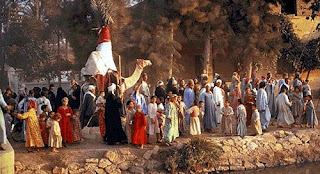
"In the poorer weddings there are no carriages. All the party walk, accompanied by the clang of instruments, and the bride is in a sort of Jack-in-the-green, which screens her from the public gaze; but there is such a throng about her, and so much dust, that I think she must be stifled!”
An 18th - early 19th century "Jack-in-the-Green" in a Maytime celebration in London - doubtless a scene that Ellen remembered from childhood. Compare the appearance of the "Jack" to the bride in the picture above.
 (A “Jack-in-the-green” is a traditional character in English Maytime celebrations, and is no doubt very ancient in origin, representing the annual re-growth of plants and crops. A person wears a conical or pyramid-shaped framework, covered in foliage. Traditional Maytime celebrations declined during the 19th century, but the Jack-in-the-green was obviously still a familiar character, at least in the 1870s. The revival of English folk-song and dance since the early 20th century has led to the character re-appearing, usually as part of a Morris-Dance).
Still, there was one festival that Ellen could experience – Ramadan. However, she was uneasy: “We had seen the effect of this formidable fast the year before, and by no means looked forward to it.”
Indeed, Princess Zeynab fell ill with a severe sore throat (although of course being ill, she was permitted to avoid, or postpone, her fast). She suffered a great deal from such sore throats, and indeed, her terminal illness began with one. Ellen found Princess Zeynab in bed, ill, “suffering from the throat, an indisposition to which she was very liable. Of course she could do no lessons, and at first she seemed unwilling that Kopsès should do any, saying that Kopsès would get on before her; but I counted nine persons around her bed, and said surely she did not want ten, so she gave up with her usual sweetness of temper, and Kopsès came with me.”
What was this disease? Certainly it recurred during Zeynab’s life, Ellen saying that “she had been subject to this illness from early childhood.” It involved “an enlargement of the uvula, which would sometimes swell so much as to touch the larynx and nearly choke her.” Fortunately most attacks seemed to have been of short duration, as Ellen was to describe playing duets (presumably on a piano) with her only a “day or two after.” One guess would be tonsillitis; this certainly appears to have been the diagnosis at the time, as a tonsillectomy was suggested, using a new method of surgery, which, however, the Princess unfortunately declined to have.
Indeed, the Princess’s last illness started with a severe sore throat, which might perhaps raise the possibility that her death at least partly resulted in septicaemia, from abscesses developing on her tonsils, although her death was diagnosed at the time as being the result of typhoid.
Ellen found that teaching in the harem was not easy. “We were constantly interrupted in our lessons by the slaves, who came in without scruple, sometimes talked either to my pupils or among themselves, and finally, finding themselves unnoticed, went away again, generally leaving all the doors open. As a rule all doors are left open; my shutting them was an innovation.”
The reason for this was because: “Every Princess has a great many attendants attached to her person, whose business it is to amuse her, and to anticipate her every want. To leave her alone would be considered a shocking neglect. …No place is sacred from their intrusion; they cannot understand any one wishing to be alone and undisturbed. My pupils knew this well, so they never rebuked them.”
Sometimes, however, the visitor was considerably more important. Whilst Ellen was teaching Kopsès during Princess Zeynab’s illness: “the door opened again for the seventh or eighth time, and looking around, I saw a gentleman standing in the doorway. I forgot for the moment that I was in an harem, and my near sight prevented me from distinguishing who it was.” In fact, it was Ismail himself. (Ellen was, unfortunately, very short-sighted). Ellen was disappointed that Princess Zeynab was not there, “as I should have been so glad for him [Ismail] to have seen the progress she had made.”
No sooner had Ismail left, than the Second Princess came in. “She asked me in Turkish how I was, and I was able to reply to that question, but could not remember one of the polite speeches which I had been getting up.”
One of the nice things about Ellen is that she never minded revealing her own small failings and weaknesses. After all, Recollections of an Egyptian Princess is partly autobiography (or, more accurately, a memoir). Indeed, Ellen herself appears in it far more than Princess Zeynab does. Yet Ellen is never quite her own heroine. She never glorifies, or tries to justify herself, and is always ready to reveal her own small, human failings, of health, or spirits, or – as now - of forgetfulness.
About a month after returning to Cairo, Zeynab moved into the Abdeen Palace from the house next door.
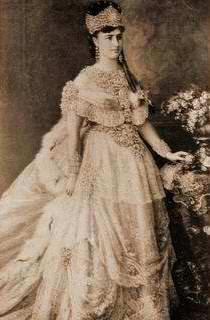 (Ismail's second daughter was in fact Princess Fatima Ismail (1853-1920), a pioneer of women's education in Egypt, who sold her jewellery and six feddans (acres) of her own land in Cairo, as well as the income from a further 658 feddans, to help pay for what is now Cairo University).
Usually, such visits would be filled with polite enquiries about families, then in drinking coffee and smoking pipes. But of course European ladies didn’t smoke pipes. Furthermore, the Princesses had “become aware that is not the custom in Europe for the lady of the house to ask her visitors whether they are married or single; if the later why they remain so, and if the former, how many children they have.” What was worse still “we had not even the resource of the weather, an unfailing topic of interest in England. It is always fine in Egypt; and we could not touch on any of the topics of the day, because the ladies of the harem neither read the newspapers nor mixed in society.”
Fortunately, after a while “more visitors arrived, and we came away”, no doubt to every one’s relief.
It did, however, get better. The day afterwards, Ellen visited Indji Hanem Effendi, who was generally known as the Princess Saïd to Europeans. Princess Indji “has been known for many years among Europeans, for her kind and courteous manners towards them.” What was more, “she had adopted in her palace many European improvements which conduce to sanitary reform”. In a hot climate, that was only too important; it is perhaps not impossible that Princess Zeynab’s illnesses and death could have resulted from inadequate sanitation.
Better still, “The Princess Saïd had a regular entertainment for us. She knew that European visitors wanted to see the amusements of harem life, and she always gratified this wish. So after the pipes and coffee, a few slaves came in with musical instruments… then five girls came in, and danced for about a quarter of an hour. They were in pale pink dresses, in the Turkish fashion – that is to say, loose, confined at the waist by a band, high up to the throat, and the skirt forming trousers, which, however, are not easily detected, as they are exceedingly full… this dress is so remarkably decent, that, although the dances usually end with a somersault, there is no further display than the soles of the feet!”
This does not seem to have been a belly-dance, but a traditional kind of dance similar to Ancient Egyptian ones. This 19th century picture shows what Ellen would have seen - right down to the traditional long-stemmed pipe (seen leaning against the table) and cup of coffee that was offered to guests.
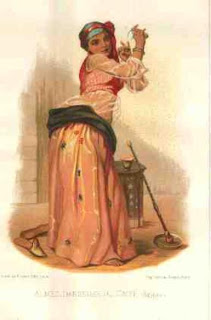
Jack-in-the-Green and other entertainments
After ten days staying at the hotel, the educational staff were able to return to Choubrah. However, Ellen somewhat regretted this, as she was no longer able to see the kind of sights that – presumably – she had gone to work abroad for.
“My windows faced the east. I saw the sun rise every morning over the Mokattam Hills, and in the evening I went up to the promenade on the roof to see it set. It is impossible to imagine a more animated scene than upon which we looked down.
"Every morning Arab weddings passed, with a long file of carriages, in the last of which the bride was seated, with large shawls or carpets thrown across the windows to conceal her from the public gaze. Let us hope she can see, though she cannot be seen!
A 19th century Arab wedding - the bride is sitting on the camel, concealed by carpets.
"In the poorer weddings there are no carriages. All the party walk, accompanied by the clang of instruments, and the bride is in a sort of Jack-in-the-green, which screens her from the public gaze; but there is such a throng about her, and so much dust, that I think she must be stifled!”
An 18th - early 19th century "Jack-in-the-Green" in a Maytime celebration in London - doubtless a scene that Ellen remembered from childhood. Compare the appearance of the "Jack" to the bride in the picture above.
 (A “Jack-in-the-green” is a traditional character in English Maytime celebrations, and is no doubt very ancient in origin, representing the annual re-growth of plants and crops. A person wears a conical or pyramid-shaped framework, covered in foliage. Traditional Maytime celebrations declined during the 19th century, but the Jack-in-the-green was obviously still a familiar character, at least in the 1870s. The revival of English folk-song and dance since the early 20th century has led to the character re-appearing, usually as part of a Morris-Dance).
Still, there was one festival that Ellen could experience – Ramadan. However, she was uneasy: “We had seen the effect of this formidable fast the year before, and by no means looked forward to it.”
Indeed, Princess Zeynab fell ill with a severe sore throat (although of course being ill, she was permitted to avoid, or postpone, her fast). She suffered a great deal from such sore throats, and indeed, her terminal illness began with one. Ellen found Princess Zeynab in bed, ill, “suffering from the throat, an indisposition to which she was very liable. Of course she could do no lessons, and at first she seemed unwilling that Kopsès should do any, saying that Kopsès would get on before her; but I counted nine persons around her bed, and said surely she did not want ten, so she gave up with her usual sweetness of temper, and Kopsès came with me.”
What was this disease? Certainly it recurred during Zeynab’s life, Ellen saying that “she had been subject to this illness from early childhood.” It involved “an enlargement of the uvula, which would sometimes swell so much as to touch the larynx and nearly choke her.” Fortunately most attacks seemed to have been of short duration, as Ellen was to describe playing duets (presumably on a piano) with her only a “day or two after.” One guess would be tonsillitis; this certainly appears to have been the diagnosis at the time, as a tonsillectomy was suggested, using a new method of surgery, which, however, the Princess unfortunately declined to have.
Indeed, the Princess’s last illness started with a severe sore throat, which might perhaps raise the possibility that her death at least partly resulted in septicaemia, from abscesses developing on her tonsils, although her death was diagnosed at the time as being the result of typhoid.
Ellen found that teaching in the harem was not easy. “We were constantly interrupted in our lessons by the slaves, who came in without scruple, sometimes talked either to my pupils or among themselves, and finally, finding themselves unnoticed, went away again, generally leaving all the doors open. As a rule all doors are left open; my shutting them was an innovation.”
The reason for this was because: “Every Princess has a great many attendants attached to her person, whose business it is to amuse her, and to anticipate her every want. To leave her alone would be considered a shocking neglect. …No place is sacred from their intrusion; they cannot understand any one wishing to be alone and undisturbed. My pupils knew this well, so they never rebuked them.”
Sometimes, however, the visitor was considerably more important. Whilst Ellen was teaching Kopsès during Princess Zeynab’s illness: “the door opened again for the seventh or eighth time, and looking around, I saw a gentleman standing in the doorway. I forgot for the moment that I was in an harem, and my near sight prevented me from distinguishing who it was.” In fact, it was Ismail himself. (Ellen was, unfortunately, very short-sighted). Ellen was disappointed that Princess Zeynab was not there, “as I should have been so glad for him [Ismail] to have seen the progress she had made.”
No sooner had Ismail left, than the Second Princess came in. “She asked me in Turkish how I was, and I was able to reply to that question, but could not remember one of the polite speeches which I had been getting up.”
One of the nice things about Ellen is that she never minded revealing her own small failings and weaknesses. After all, Recollections of an Egyptian Princess is partly autobiography (or, more accurately, a memoir). Indeed, Ellen herself appears in it far more than Princess Zeynab does. Yet Ellen is never quite her own heroine. She never glorifies, or tries to justify herself, and is always ready to reveal her own small, human failings, of health, or spirits, or – as now - of forgetfulness.
About a month after returning to Cairo, Zeynab moved into the Abdeen Palace from the house next door.
Entrance to the Abdeen Palace, early 20th century
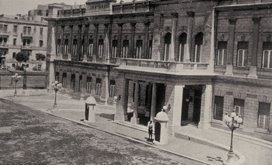
Ellen didn’t like the Abdeen Palace. “The entrance was a most disagreeable one at that time, You first had to pass through an outer court, in which were soldiers, grooms, carriages, carts, &c., &c.; then into a second full of eunuchs. Here you left the carriage; but there were several doors, and you did not know which to take to enter the harem.” The Palace, indeed, was a maze. First she asked some unhelpful eunuchs, who eventually directed her to a door behind which was a “labyrinth of passages”. Here, she “met several girls, but they did not appear to understand my enquiries, or at any rate did not answer them. At last I emerged upon an inner court, and after crossing that, found myself in some of the best apartments. Here my enquiries were more successful, and I was presently led to her apartments.”
She had, in fact, entered the Palace from the rear. But entering from the front was not an option; “if I went to the chief gate, I might constantly find myself much delayed by the absence of the head eunuchs, and by the gate being locked.”
Ramadan ended on 1 December in 1872, and as the year before, Ellen went to pay her respects to the Princesses. This year, however, she took three (female) English friends with her, “as travellers are always very desirous of being present at these festivals.”
Unhappily, it all fell rather flat, although on this occasion Ellen had an interpreter, a (presumably) French lady, referred to only as “Mademoiselle O”, who “resided in the harem with his Highness’s second daughter."
Princess Fatima Ismail
 (Ismail's second daughter was in fact Princess Fatima Ismail (1853-1920), a pioneer of women's education in Egypt, who sold her jewellery and six feddans (acres) of her own land in Cairo, as well as the income from a further 658 feddans, to help pay for what is now Cairo University).
Usually, such visits would be filled with polite enquiries about families, then in drinking coffee and smoking pipes. But of course European ladies didn’t smoke pipes. Furthermore, the Princesses had “become aware that is not the custom in Europe for the lady of the house to ask her visitors whether they are married or single; if the later why they remain so, and if the former, how many children they have.” What was worse still “we had not even the resource of the weather, an unfailing topic of interest in England. It is always fine in Egypt; and we could not touch on any of the topics of the day, because the ladies of the harem neither read the newspapers nor mixed in society.”
Fortunately, after a while “more visitors arrived, and we came away”, no doubt to every one’s relief.
It did, however, get better. The day afterwards, Ellen visited Indji Hanem Effendi, who was generally known as the Princess Saïd to Europeans. Princess Indji “has been known for many years among Europeans, for her kind and courteous manners towards them.” What was more, “she had adopted in her palace many European improvements which conduce to sanitary reform”. In a hot climate, that was only too important; it is perhaps not impossible that Princess Zeynab’s illnesses and death could have resulted from inadequate sanitation.
Better still, “The Princess Saïd had a regular entertainment for us. She knew that European visitors wanted to see the amusements of harem life, and she always gratified this wish. So after the pipes and coffee, a few slaves came in with musical instruments… then five girls came in, and danced for about a quarter of an hour. They were in pale pink dresses, in the Turkish fashion – that is to say, loose, confined at the waist by a band, high up to the throat, and the skirt forming trousers, which, however, are not easily detected, as they are exceedingly full… this dress is so remarkably decent, that, although the dances usually end with a somersault, there is no further display than the soles of the feet!”
This does not seem to have been a belly-dance, but a traditional kind of dance similar to Ancient Egyptian ones. This 19th century picture shows what Ellen would have seen - right down to the traditional long-stemmed pipe (seen leaning against the table) and cup of coffee that was offered to guests.
Friday, November 21, 2008
Recollections of Egyptian Princesses
ELLEN CHENNELLS (Continued)
19th. century Egyptian carriage driver
Back in Cairo
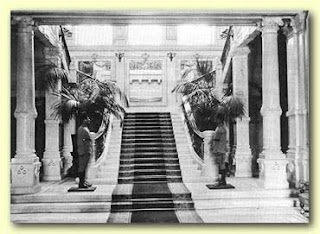
The Palace was, at that time, still under construction. Building had started in 1863, and was to continue until 1874; evidently, however, by late 1872 enough of it was complete for the Khedival family to move in. Following Ismail’s taste for Parisian style architecture, it had been designed by a French architect.
Ellen gives a description of the Khedival family’s life at Abdeen, which has a certain rarity value, as in fact the Khedival family were to spend very little time there in the future, with the Palace being mainly used as government offices.
Construction work meant that, at first, Princess Zeynab and Kopsès did not live in the Palace itself, but in an adjoining house, belonging to the then Minister of Finance, Ismael Sadyk Pasha. Sadyk, Ellen explains, was at that time: “in high favour, but a few years after disgraced and exiled to Dongola.”
“The time of my coming and going”, Ellen wrote “was to be fixed by myself, and the [Princess’s] Turkish and Arabic lessons were to be arranged accordingly.” However, she rather ominously went on to mention that “the Princess no longer rose so early as she had been accustomed to do when she came to us.” In other words, Princess Zeynab, like all other teenagers, had a tendency to sleep in!
The Princess had previously been awoken in time to go for her lessons by her attendants, “who would be blamed if she was late… But all this changed in the harem, as I soon had occasion to see. Perhaps the Princess might have sat up late at night, and as a growing girl she required much sleep. In the morning the rooms were all darkened, and not a sound was to be heard until the Princess became wide awake of her own accord, and called out to her slaves to come and dress her.”
This was only the start of a sort of comedy of every one not arriving on time.
By October 1872, Ellen was: “constantly expecting the order for our return. At last it came, and we were told we were to go on board the Masr [in fact the ship's name was el-Misr, “Egypt”], one of the steam-yachts belonging to his Highness, which was moored in front of the palace. Our pupils were to return on the Mahroussah with the Second Princess.”
The el-Misr had taken part in the opening celebrations for the Suez Canal in 1869, when it had carried, amongst others, Sir Frederick Arrow, the Deputy Master of Trinity House. (Trinity House is the organisation responsible for lighthouses, and other navigational aids, in England and Wales). Sir Frederick described the ship as being “a large, powerful screw vessel, fitted up as a passenger vessel, but loaded with gilding and beautiful wood carving, her occupation being, about once a year, to take the Viceroy’s entourage for a sniff of the briny.”
Sir Frederick, a former Master Mariner, would not have approved of the running of the ship when Ellen voyaged on board it. “We, the educational staff, and Mrs. Freeland and her children, went on board the Masr on the morning of the 14th, [October] and were much annoyed to find that one of the cabins which we had taken had been appropriated to some one else… there was no one to regulate and arrange as on European ships.” What was more: “The hot deck was very crowded and dirty. I wonder what an English sailor would say to their mode of washing it! They throw down a quantity of water, and then drag along a piece of flannel to wipe it up!”
Still, apart from this, Ellen was generally pleased with the ship. “We went to look at the accommodation on the Masr, and were very well satisfied with it… the Masr had also splendid harem apartments; but there were many excellent cabins all over the ship … The windows in the cabins were large, so I hoped to see something of the land we might pass, while dressing in the morning.”
A fellow passenger had an interesting story, recounted by Ellen. Some years previously, a wealthy woman had wanted to make the hajj, the pilgrimage to Mecca. However, she could only do this as a married woman. Ellen takes up the story: “Strange as it may appear, I was told that temporary marriages are often made by rich women for that purpose. So the lady in question married a poor man, and after the pilgrimage was accomplished she departed from her temporary husband, making him a handsome present in return for his protection.”
However, protection was not all that she got from him. “A daughter was, however the result of the connection, who was brought up by her mother and received a good education. In the meantime, the repudiated husband went to Egypt, entered the service of the Viceroy, and rose to rank and dignity. The father, now become a great man, conceived a wish to see his daughter, who was married and had one or more children. So the lady was in the same vessel with us, in the part devoted to the harem, on her way to Egypt to visit the father whom she had never yet beheld.”
Who says that stories never have happy endings!
But it was not to be so happy for Princess Zeynab, who would be confined to the harem on her return to Egypt. “My dear little pupil was now “shut up.””, Ellen wrote. “Her last day of liberty had bee that on which she left Emirghian. Henceforward I was now to go to her daily to give lessons in the harem.” Kopsès was also to live in the harem, with Zeynab; of course as a slave she had even less choice about it than Zeynab did. Both seem to have merely accepted it as inevitable; on her first visit to the harem to give them lessens, Ellen found they: “were very quiet, and said nothing whatever of the change that had taken place in their condition since I last saw them.”
Ellen, however, felt deeply for them. “It really went to my heart to see them thus caged”, she wrote, “because they had known what liberty was, and lost it just at the age when its deprivation would have been felt the most.” (Princess Zeynab was now aged 14, and Kopsès perhaps slightly older; evidently they had entered the harem at puberty).
The el-Misr had taken part in the opening celebrations for the Suez Canal in 1869, when it had carried, amongst others, Sir Frederick Arrow, the Deputy Master of Trinity House. (Trinity House is the organisation responsible for lighthouses, and other navigational aids, in England and Wales). Sir Frederick described the ship as being “a large, powerful screw vessel, fitted up as a passenger vessel, but loaded with gilding and beautiful wood carving, her occupation being, about once a year, to take the Viceroy’s entourage for a sniff of the briny.”
Sir Frederick, a former Master Mariner, would not have approved of the running of the ship when Ellen voyaged on board it. “We, the educational staff, and Mrs. Freeland and her children, went on board the Masr on the morning of the 14th, [October] and were much annoyed to find that one of the cabins which we had taken had been appropriated to some one else… there was no one to regulate and arrange as on European ships.” What was more: “The hot deck was very crowded and dirty. I wonder what an English sailor would say to their mode of washing it! They throw down a quantity of water, and then drag along a piece of flannel to wipe it up!”
Still, apart from this, Ellen was generally pleased with the ship. “We went to look at the accommodation on the Masr, and were very well satisfied with it… the Masr had also splendid harem apartments; but there were many excellent cabins all over the ship … The windows in the cabins were large, so I hoped to see something of the land we might pass, while dressing in the morning.”
A fellow passenger had an interesting story, recounted by Ellen. Some years previously, a wealthy woman had wanted to make the hajj, the pilgrimage to Mecca. However, she could only do this as a married woman. Ellen takes up the story: “Strange as it may appear, I was told that temporary marriages are often made by rich women for that purpose. So the lady in question married a poor man, and after the pilgrimage was accomplished she departed from her temporary husband, making him a handsome present in return for his protection.”
However, protection was not all that she got from him. “A daughter was, however the result of the connection, who was brought up by her mother and received a good education. In the meantime, the repudiated husband went to Egypt, entered the service of the Viceroy, and rose to rank and dignity. The father, now become a great man, conceived a wish to see his daughter, who was married and had one or more children. So the lady was in the same vessel with us, in the part devoted to the harem, on her way to Egypt to visit the father whom she had never yet beheld.”
Who says that stories never have happy endings!
But it was not to be so happy for Princess Zeynab, who would be confined to the harem on her return to Egypt. “My dear little pupil was now “shut up.””, Ellen wrote. “Her last day of liberty had bee that on which she left Emirghian. Henceforward I was now to go to her daily to give lessons in the harem.” Kopsès was also to live in the harem, with Zeynab; of course as a slave she had even less choice about it than Zeynab did. Both seem to have merely accepted it as inevitable; on her first visit to the harem to give them lessens, Ellen found they: “were very quiet, and said nothing whatever of the change that had taken place in their condition since I last saw them.”
Ellen, however, felt deeply for them. “It really went to my heart to see them thus caged”, she wrote, “because they had known what liberty was, and lost it just at the age when its deprivation would have been felt the most.” (Princess Zeynab was now aged 14, and Kopsès perhaps slightly older; evidently they had entered the harem at puberty).
Princess Zeynab, perhaps not long before she entered the harem. However her short (by the standards of the time) French style skirt indicates that she had not yet, however, quite reached puberty when this photo was taken.
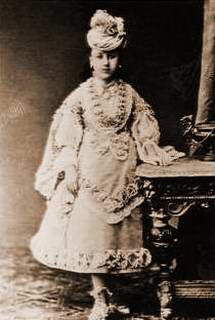
William Loring, indeed, wrote that Princess Zeynab "rebelled when the time came for her incarceration, and that she lamented in tears her unfortunate fate." This may well be true, although Ellen (perhaps diplomatically) does not mention it.
Still, like so much else, neither Zeynab or even it seems Ismail himself, could have done anything about it, as Ellen explained:
“The Khédive did all that lay in his power to give his daughter careful and moral training in early youth, but he could not set aside the opinion of all Mahometans [sic], which would have been outraged by her retaining that liberty when arrived at womanhood.”
And Ismail could not have afforded that. He was already unpopular for favouring foreigners with the strong nationalist movement that was developing in Egypt during the 1870s; this was, after all, a mere seven years before the start of the Urabi Revolt against Ismail and the undue influence of foreigners – specifically Europeans, Turko-Circassians and Albanians.
Indeed, the two women closest to Princess Zeynab at this time, apart from her mother, the Second Princess, were two such: Ellen, a European, and Kopsès, who appears to have been Circassian. Ismail might have felt it best not to publicise this fact too much, as it certainly risked being commented on unfavourably by the popular, and increasingly nationalist Egyptian press of the time.
What was more, Ismail seems to have hoped that his daughter would carry forwards his plans for the increasing westernisation of Egypt. And that would require tact; according to Ellen the plan seems to have involved “marrying her early, and then encouraging her gradually and innocently to introduce European customs”.
It all inevitably lead to the question, did Ellen, however innocently and indirectly, have any kind of political role? Or to put it more simply, whose side was she on? After all, it would perhaps be naïve not to imagine that she was completely outside the political sphere, as one of the main influences on a member of the Egyptian Royal Family. And she certainly had associations, at least, with British Establishment circles.
The answer seems to have been that, if anything, she was loyal to the Khedival family, even delaying publishing her book – despite her need to earn money – until its appearance could not offend, or harm any of them. And indeed, it seems to have been her intention to remain in Egypt, even when her employment there had ended, as she wrote that she left it “with deep regret”, and felt that it had “an attraction surpassing that of all other countries.” (Including, evidently, Britain).
She does not say, indeed, why she had to return. All that we do know is that she went to live with her older sister, Anne Lydia, in Cheltenham, so it may be possible that it was to care for Anne Lydia, who may possibly have been in poor health, as she was not to live for many more years.
Ellen did not immediately return to the house in Choubrah on her return to Cairo, as it was needed for part of the retinue of Grand Duke Nicholas of Russia (whether the elder or the younger of that name is not specified), visiting Egypt after having visited Constantinople. For Ellen, this simply meant having to live in an hotel for a while. But it would seem likely that the Grand Duke’s visit concerned the tensions that were increasingly building up in the Ottoman Empire, particularly in the Balkans, and which were to lead to the Russo-Turkish War of 1877-1878, and the increased intervention of European powers in the region.
In the past, Princess Zeynab and Kopsès had travelled to Choubrah for their lessons. Now Ellen had to travel to the palaces to teach them. Ellen only regretted that the two young women were thereby deprived of a daily ride outside.
The Khedive, and his family had returned from Constantinople to the Abdeen palace, which, according to Ellen, they used as their winter palace.
Entrance Hall of the Abdeen Palace, early 20th century
The Palace was, at that time, still under construction. Building had started in 1863, and was to continue until 1874; evidently, however, by late 1872 enough of it was complete for the Khedival family to move in. Following Ismail’s taste for Parisian style architecture, it had been designed by a French architect.
Ellen gives a description of the Khedival family’s life at Abdeen, which has a certain rarity value, as in fact the Khedival family were to spend very little time there in the future, with the Palace being mainly used as government offices.
Construction work meant that, at first, Princess Zeynab and Kopsès did not live in the Palace itself, but in an adjoining house, belonging to the then Minister of Finance, Ismael Sadyk Pasha. Sadyk, Ellen explains, was at that time: “in high favour, but a few years after disgraced and exiled to Dongola.”
“The time of my coming and going”, Ellen wrote “was to be fixed by myself, and the [Princess’s] Turkish and Arabic lessons were to be arranged accordingly.” However, she rather ominously went on to mention that “the Princess no longer rose so early as she had been accustomed to do when she came to us.” In other words, Princess Zeynab, like all other teenagers, had a tendency to sleep in!
The Princess had previously been awoken in time to go for her lessons by her attendants, “who would be blamed if she was late… But all this changed in the harem, as I soon had occasion to see. Perhaps the Princess might have sat up late at night, and as a growing girl she required much sleep. In the morning the rooms were all darkened, and not a sound was to be heard until the Princess became wide awake of her own accord, and called out to her slaves to come and dress her.”
This was only the start of a sort of comedy of every one not arriving on time.
On the first morning of lessons at the harem, a carriage came to the hotel for Ellen at seven o’clock in the morning. Ellen had not yet even breakfasted, so she arranged for the carriage to come again at nine, which it did. Ellen then (somewhat optimistically, as it turned out) arranged the times when she would come, and leave in future, with Princess Zeynab.
“After consultation,” Ellen wrote, “I settled that I would come every morning at half-past eight, and leave at twelve”. (The Princess had Arabic and Turkish lessons in the afternoon). “…the carriage was ordered to fetch me from the hotel at that hour.”
“After consultation,” Ellen wrote, “I settled that I would come every morning at half-past eight, and leave at twelve”. (The Princess had Arabic and Turkish lessons in the afternoon). “…the carriage was ordered to fetch me from the hotel at that hour.”
19th. century Egyptian carriage driver

But: “the next morning at ten no carriage had arrived so I sent… to ask the reason. …On enquiring why it was so late, I was told it was because I had objected to it going so early the day before! …When I arrived at the palace, I found that the Princess had been waiting for me for more than an hour. I was much vexed, and requested that positive [i.e. firm] directions should be given to fetch me every morning at the time named.”
The following morning, the carriage came for Ellen again at seven o’clock. “I swallowed a hasty breakfast and went to the harem, where I found the Princess not dressed and amazed at my having come so early. The eunuch had simply told the coachman that he was to go earlier, so he thought he would come in time!”
Princess Zeynab herself awoke at varying times. “From the time of her seclusion in the harem, she always took breakfast, luncheon, and dinner with his Highness [i.e. Ismail], but the time for the first meal was not very regular. His Highness transacted much business before breakfast, so that it might be late. Someone was on the watch to give notice when he was coming, and then if the Princess was sleeping, her attendants did not hesitate to awaken her, and hurry through the toilet.” A late breakfast would affect the time when Ellen was able to start lessons.
Things did not improve much. “The same unpunctuality with the carriage went on in spite of the repeated orders of the Princess. It sometimes came an hour before time, and sometimes an hour after. There was always the same difficulty in getting away.” That is, a carriage was never available to taker her back.
However, by chance, whilst Ellen waiting for a carriage home one afternoon, Ismail walked past. Princess Zeynab seized the opportunity, and “drew me gently into an apartment just at the entrance [of the harem], whilst she herself waited the coming of her father. As the Khédive passed the room in which I was, he caught sight of the European dress, and I heard him ask his daughter who it was.
“It is my governess, who is waiting for the carriage to take her away.”
“And why don’t you order it?” said his Highness.
“I have done so, but they do not come.”
“What! not obey my daughter!” said the Khédive.
He walked quickly towards the door, and called loudly that a carriage was to come up immediately…”
Still, by now Ellen had had enough of this, and so wrote a letter of complaint to the Second Princess. And sure enough, “The next morning, at eight o’clock, I was surprised to see a pretty open carriage at the door… the Khédive had given orders that a carriage wshould be sent for me every morning at eight, and that it was to bring me back at twelve; that I was at liberty to order it whenever I wished for a drive in the afternoon, or go to the opera, or French theatre in the evening.”
However:
“For the first week or two I had a very nice carriage, then an inferior one was substituted, and I was told it was solely to take me to and from the harem daily…”
Ellen more-or-less gave up. “I believe the Khédive wishes to act fairly and liberally” she wrote, “but there is such a jealousy existing, first, between natives and foreigners, and secondly, between the different nationalities, that the officials manage constantly to evade the Khédive’s orders; and though you may sometimes succeed in making your complaint reach his ears, so as to obtain temporary redress, the tables are sure to be turned on you in the end.”
For Ellen, this jealousy between natives and foreigners and between different nationalities was a mere inconvenience. For Egypt itself, it was soon, unfortunately, to have tragic and far-reaching consequences.
The following morning, the carriage came for Ellen again at seven o’clock. “I swallowed a hasty breakfast and went to the harem, where I found the Princess not dressed and amazed at my having come so early. The eunuch had simply told the coachman that he was to go earlier, so he thought he would come in time!”
Princess Zeynab herself awoke at varying times. “From the time of her seclusion in the harem, she always took breakfast, luncheon, and dinner with his Highness [i.e. Ismail], but the time for the first meal was not very regular. His Highness transacted much business before breakfast, so that it might be late. Someone was on the watch to give notice when he was coming, and then if the Princess was sleeping, her attendants did not hesitate to awaken her, and hurry through the toilet.” A late breakfast would affect the time when Ellen was able to start lessons.
Things did not improve much. “The same unpunctuality with the carriage went on in spite of the repeated orders of the Princess. It sometimes came an hour before time, and sometimes an hour after. There was always the same difficulty in getting away.” That is, a carriage was never available to taker her back.
However, by chance, whilst Ellen waiting for a carriage home one afternoon, Ismail walked past. Princess Zeynab seized the opportunity, and “drew me gently into an apartment just at the entrance [of the harem], whilst she herself waited the coming of her father. As the Khédive passed the room in which I was, he caught sight of the European dress, and I heard him ask his daughter who it was.
“It is my governess, who is waiting for the carriage to take her away.”
“And why don’t you order it?” said his Highness.
“I have done so, but they do not come.”
“What! not obey my daughter!” said the Khédive.
He walked quickly towards the door, and called loudly that a carriage was to come up immediately…”
Still, by now Ellen had had enough of this, and so wrote a letter of complaint to the Second Princess. And sure enough, “The next morning, at eight o’clock, I was surprised to see a pretty open carriage at the door… the Khédive had given orders that a carriage wshould be sent for me every morning at eight, and that it was to bring me back at twelve; that I was at liberty to order it whenever I wished for a drive in the afternoon, or go to the opera, or French theatre in the evening.”
However:
“For the first week or two I had a very nice carriage, then an inferior one was substituted, and I was told it was solely to take me to and from the harem daily…”
Ellen more-or-less gave up. “I believe the Khédive wishes to act fairly and liberally” she wrote, “but there is such a jealousy existing, first, between natives and foreigners, and secondly, between the different nationalities, that the officials manage constantly to evade the Khédive’s orders; and though you may sometimes succeed in making your complaint reach his ears, so as to obtain temporary redress, the tables are sure to be turned on you in the end.”
For Ellen, this jealousy between natives and foreigners and between different nationalities was a mere inconvenience. For Egypt itself, it was soon, unfortunately, to have tragic and far-reaching consequences.
To be continued
Thursday, November 20, 2008
Charges of The Goddess.

The Charges of the Goddess
The Charge of the Goddess is a beautiful poetic affirmation that I like to recall every full moon as do many other Goddess devotee’s.The original version which follows by Doreen Valiente was purported to have been found in a Gardenerian book of shadows and adapted by renowned Priestess Doreen.
Many people prefer to adapt these words into something more personal which resonates with their own belief system. The Charge of the Goddess is a powerful spell which reminds us to honour the divine feminine & also affirm that we can focus on our own goals at this time.
I particularly like the paragraph by Starhawk which states:
“And you who seek to know me, know that the seeking and yearning will avail you not, unless you know the Mystery: for if that which you seek, you find not within yourself, you will never find it without.”
It’s very easy to believe that we need something external to make us happy & that we can not enjoy life without acquiring the love of some particular person or some magical item or even a boob job!I think that she is telling us to trust in ourselves and the love of the Goddess.
The following are the most popular versions but you may find some others of your own or even prefer to write/adapt one to honour the Goddess at the time of the Full Moon.
Listen to the words of the Great Mother; she who of old was also called among men Artemis, Astarte, Athene, Dione, Melusine, Aphrodite, Cerridwen, Cybele, Arianrhod, Isis, Dana, Bride, and by many other names:
Whenever ye have need of anything, once in the month, and better it be when the moon is full, then shall ye assemble in some secret place and adore the spirit of me, who am Queen of all the witches.There shall ye assemble, ye who are fain to learn all sorcery, yet have not won its deepest secrets; to these will I teach things that are yet unknown.
And ye shall be free from slavery; and as a sign that ye be really free, ye shall be naked in your rites; and ye shall dance, sing, feast, and make music and love, all in my praise.
For mine is the ecstasy of the spirit and mine also is joy on earth; for my law is love unto all beings.
Keep pure your highest ideal; strive ever towards it; let naught stop you or turn you aside.
For mine is the secret door which opens upon the Land of Youth, and mine is the cup of the wine of life, and the Cauldron of Cerridwen, which is the Holy Grail of immortality.
I am the Gracious Goddess, who gives the gift of joy unto the heart of man.Upon earth, I give the knowledge of the spirit eternal; and beyond death, I give peace and freedom and reunion with those who have gone before.
Nor do I demand aught in sacrifice; for behold, I am the Mother of all living, and my love is poured out upon the earth.
Hear ye the words of the Star Goddess; she in the dust of whose feet are the hosts of heaven, and whose body encircles the Universe.
I who am the beauty of the green earth, and the white Moon among the stars, and the mystery of the waters, and the desire of the heart of man, call unto thy soul. Arise, and come unto me.
For I am the soul of nature, who gives life to the universe. From me all things proceed, and unto me all things must return; and before my face, beloved of Gods and of men, let thine innermost divine self be enfolded in the rapture of the infinite.
Let my worship be within the heart that rejoiceth; for behold, all acts of love and pleasure are my rituals. And therefore let there be beauty and strength, power and compassion, honour and humility, mirth and reverence within you
.And thou who thinkest to seek for me, know thy seeking and yearning shall avail thee not unless thou knowest the mystery;that if that which thou seekest thee findest not within thee, thou wilt never find it without thee. For behold, I have been with thee from the beginning; and I am that which is attained at the end of desire.
By Starhawk.
Listen to the words of the Great Mother, who of old was calledArtemis, Astarte, Dione, Melusine, Aphrodite,Cerridwen, Diana, Arionrhod, Brigid, and by many other names:
Whenever you have need of anything, once a month, and better it be when the moon is full, you shall assemble in some secret place and adore the spirit of Me Who is Queen of all the Wise.
You shall be free from slavery, and as a sign that you be free you shall be naked in your rites.
Sing, feast, dance, make music and love, all in my presence, for mine is the ecstasy of the spirit and mine also is joy on Earth.
For My law is love unto all things. Mine is the secret that opens the door of youth, and mine is the cup of wine of life that is the Cauldron of Cerridwen, that is the holy grail of immortality.
I give the knowledge of the spirit eternal, and beyond death I give peace and freedom and reunion with those that have gone before.
Nor do I demand aught of sacrifice, for behold, I am the Mother of all things and my love is poured out upon the Earth.
Hear the words of the Star Goddess, the dust of whose feet are the hosts of Heaven, Whose body encircles the universe. I who am the beauty of the green earth and the white moon among the stars and the mysteries of the waters, I call upon your soul to arise and come unto me.
For I am the soul of nature that gives life to the universe. From me all things proceed and unto Me they must return.Let my worship be in the heart that rejoices, for behold, all acts of love and pleasure are my rituals.
Let there be beauty and strength, power and compassion, honour and humility, mirth and reverence within you.
And you, who seek to know me, know that the seeking and yearning will avail you not, unless you know the Mystery:
for if that which you seek, you find not within yourself, you will never find it without.For behold, I have been with you from the beginning, and I am that which is attained at the end of desire.
There shall ye assemble, ye who are fain to learn all sorcery, yet have not won its deeper secrets; to these will I teach all things that are as yet unknown, And ye shall be free from slavery;
and as a sign ye be truly free, you shall be naked in your rites, and ye shall dance, sing and feast, make music and love, all in my praise.
For mine is the ecstasy of the spirit, and more and mine is also Joy on Earth; for my law is love unto all beings.
Keep pure your highest ideals; strive ever towards them, let nothing stop you or turn you aside. For mine is the secret door which opens upon the Land of Youth, and mine is the cup of the of the wine of life, and the Cauldron of Cerridwen, which is the Holy Vessel of Immortality.
I am the Gracious Goddess, who gives the gift of joy unto the heart of man. Upon Earth, I give the knowledge of the spirit eternal; and beyond death, I give peace and freedom, and reunion with those who have gone before.
Nor do I demand sacrifice for behold, I am the Mother of all living, and my love is poured out onto the Earth.
I am the beauty of green earth, and the white moon among the stars, and the mystery of the waters, and the desire of the heart of man.
Call unto thy soul, arise, and come unto me.For I am the soul of nature. Who gives life to the universe.
From me all things proceed, and unto me all things must return; and before my face, beloved of Gods and men, let thine innermost divine self be enfolded in the rapture of the infinite.
Let my worship be within the heart that rejoiceth; for behold all acts of love and pleasure are my rituals.
Therefore, let there be beauty and strength, power and compassion, honour and humility, mirth and reverence within you.
And thou who thinketh to seek for me, know thy seeking and yearning shall avail thee not unless thou knoweth the mystery; that if that which thy seekest thou findest not within thee, thou wilt never it without thee.
For behold, I have been with thee from the beginning; and I am that which is attained at the end of desire. So says the Goddess...
Hear my words and know me! I shall be called a million names by all who speak!
I am Eternal Maiden! I am Great Mother! I am the Old One who holds the immortal key!
I am shrouded in Mystery, but am known to every soul.
Hear my words and know me!
Whenever the moon rises in the Heavens shall my children come to me.
Better it be once a month when the moon is full, shall ye assemble in some secret place, such as this, and adore the spirit of I.
I, who am the Queen of Witches! And under my watchful eye, my children shall be taught the mysteries of Earth and Nature, of the ways of all Magick!
That which is unknown shall be known, and that which is hidden shall be revealed, even the secluded soul shall be pierced with my Light.
From my cauldron shall be drunk all knowledge and immortality! Ye shall be free from slavery and ye shall dance, sing, and feast.
Music shall surround you, for mine is the ecstasy of the spirit, and mine is also the joy of the earth!
I do not demand sacrifice! For behold, I am the Mother of all living things!
Create and heal! Be strong, yet gentle. Be noble, yet reverent.
Bring forth and replenish. And, as does the cycle of the Moon ever begin to wax and wane and to grow forth again, as do the seasons from one to the next flow in smooth rhythm, from sowing to reaping, to seeming death and rebirth.....So will my children know their own pattern in both worlds!
And ye shall say these words...I will love and harm none.
I Will live, love, die, and live again. I will meet, remember, and know. And embrace once more
.For the free will of ALL, and with harm to None As I will it now is done So mote it be!
Whenever you have need of anything, one in the month and be it better when the moon is full, then shall you assemble in some secret place and adore the spirit of me, who am the Queen of all witches.
When I have departed from this world, Whenever you have need of anything, Once a month, and when the moon is full, Ye shall assemble in some desert place or in a forest all together join to adore the potent spirit of your Queen My mother, great Diana, She who fain Would learn all sorcery yet has not won Its deepest secrets, then my mother will Teach her, in truth all things as yet unknown.
Subscribe to:
Posts (Atom)

 Posts
Posts


